Showing posts with label marketing. Show all posts

Friday, October 4, 2013

Use of Psychological Manipulation of Physicians to Sell Pharmaceuticals: The Drug Representative as "Den Mother"

We have discussed, most recently here, how marketers of health care goods and services use deception and psychological manipulation to sell their goods.  Physicians, of course, are particular targets of marketers of drugs and devices. 

A vivid anecdote showing how this works just appeared on a New York Times blog.  It may be easier to recall that psychological theories:

In the social and culinary wasteland that was residency training, it had been easy for Cheryl, a bubbly brunette in her mid-30s, to become our den mother. She never tired of listening to our grousing, had unerring taste in take-out, made it a point to come to our parties when invited and every so often brought in a plate of her homemade brownies.

But Cheryl was no den mother. She was a pharmaceutical rep.

That she managed to slip a plug for her wares into every conversation or tuck copies of studies promoting her product into our white coat pockets as we polished off her brownies was awkward. But we always overlooked the salesmanship because it was such a familiar part of our residency routine. As trainees in a large teaching hospital, we knew numerous sales reps by name and the products they peddled; and it was odd, even disappointing, to go to an educational conference where one of them was not standing next to a table laden with tchotchkes, information brochures and free take-out.

 But in retrospect, such docile acceptance was problematic. In an environment where no one, including senior doctors, ever questioned the presence of sales reps, we didn’t think too hard about why they might have been as friendly and helpful as they were. We didn’t ask where the money for all these giveaways was coming from and we were rarely curious about who these reps actually were (I only ever knew their first names).

It wasn’t that I or the other residents preferentially prescribed their products. But I do know that more than once when faced with a decision about what to prescribe, the first thought that came to mind was not what I needed to do to find the latest evidence-based recommendation, but what Cheryl had just told us over lunch. 

All of this became painfully clear after Cheryl suddenly disappeared. At first, the other trainees and I thought she had been fired, so we avoided bringing her absence up with the rep who replaced her. But when I ran into someone from her company at a national medical conference a year later, I learned otherwise.

'Oh, she got promoted,' the rep said, smiling broadly. 'Now she’s an executive in the central office.' 

Since Ahari and Fugh-Berman wrote and testified about the cynical tactics used in the marketing of drugs and other medical products years ago (look here, here, and here), it is now inexcusably naive for doctors to believe that drug (or device) representatives are their friends, no matter how friendly they appear.  Drug and device reps are trained to appear to be likable.  They may look like sympathetic friends, glamorous companions, or in this case, den mothers.  But as Sah and Fugh-Berman noted (look here), likability is a ruse to sell products.  Brownies are supplied to give the appearance of warmth and comfort, and to generate feelings of reciprocity.

How well it works appears above: "the first thought that came to mind was not what I needed to do to find the latest evidence-based recommendation, but what Cheryl had told us over lunch."  That it works well is demonstrated by Cheryl's promotion to an executive office.

As long as physicians remain trusting, naive, or foolish in their approach to deceptive marketing, there will be more use of needlessly expensive, and sometimes needlessly toxic drugs, and more drug reps made into well-paid executives. 

Thursday, October 3, 2013

Words that Work: Singing Only Positive - And Often Unsubstantiated - EHR Praise As "Advised" At The University Of Arizona Health Network

When clinicians are told to promote a technology in no uncertain terms, that puts a chilling effect on critical thinking and discourse.  In effect, when under orders to only speak positively about a hospital or its technology, saying anything bad could very likely get clinicians labeled as 'troublemakers' or 'disruptive clinicians.'  Sometimes - in a sadly real example at Affinity Health - it may even get threats of having complaints plastered to one's forehead (see http://hcrenewal.blogspot.com/2013/07/hows-this-for-patient-rights-affinity.html), a threat answered to by a judge.

The 'disruptive' label usually does not have a good effect on one's evaluations and job (or, for doctors, even career) longevity.  See, for example, the resources at http://www.aapsonline.org/index.php/article/sham_peer_review_resources_physicians/ on sham peer review.

At University of Arizona Health Network (UAHN), clinicians are being told to promote the EPIC EHR.

The campaign is under the aegis of executives who know, should know, or should have made it their business to know the mayhem caused at other medical centers by EPIC and other major clinical IT systems (see for example query links http://hcrenewal.blogspot.com/search/label/EPIC and http://hcrenewal.blogspot.com/search/label/healthcare%20IT%20difficulties).

Here's what clinicians are bring told in the Oct. 3, 2013 "Weekly update for UAHN employees":

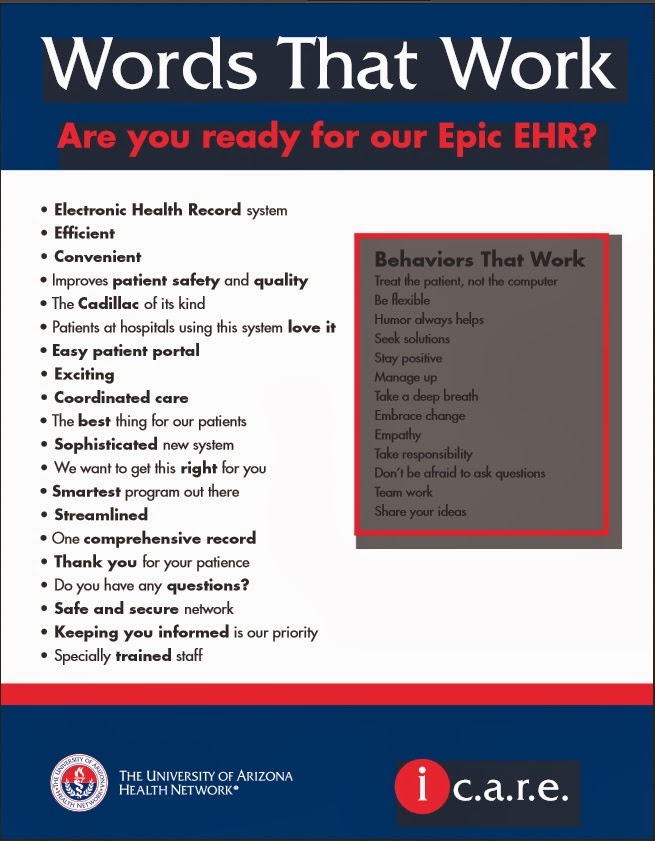
Words that Work 


Talking positively to our patients about our new Electronic Health Record system is important! Here are some key words and phrases you can use to emphasize the many benefits of the new system:
  • Electronic health record (not ‘Epic’ or ‘EHR’)
  • One comprehensive record
  • Coordinated care
  • Improves patient safety & quality
  • Convenient, easy patient portal 
  • Private and secure
Click here for more words and behaviors to inspire confidence in our patients (and ourselves) as we transition to this new system.

The link to "more words" produced this PDF:


"Words that Work" - If I worked there, I would be concerned that that using "words that don't work" about a project that probably cost hundreds of millions of dollars would likely injure my career.  Click to enlarge.

This is shameless.  Many of these claims are unsubstantiated or in significant doubt in the literature.

First:

They left out issues such as these:

• The software is tested and validated for safety by nobody, including traditional medical device safety testers.

• No postmarket surveillance for problems, either.

• Transparency about problems that can cause patient harm is severely impeded by systematic impediments to information flow (as per IOM's 2012 study of health IT safety at http://hcrenewal.blogspot.com/2012/03/doctors-and-ehrs-reframing-modernists-v.html, FDA via their leaked Internal Memo on HIT safety as at http://hcrenewal.blogspot.com/2010/08/smoking-gun-internal-fda-memorandum-of.html, the Joint Commission in their Sentinel Events Alert on Health IT as at http://hcrenewal.blogspot.com/2008/12/joint-commission-sentinel-events-alert.html, and others.)

• Problems known are only the "tip of the iceberg" (FDA, ECRI Institute), as at http://hcrenewal.blogspot.com/2010/02/fda-on-health-it-adverse-consequences.html and http://hcrenewal.blogspot.com/2013/02/peering-underneath-icebergs-water-level.html

Of the claims they do make:

Efficient - see aforementioned links as well as "Common Examples of Healthcare IT Difficulties" at http://cci.drexel.edu/faculty/ssilverstein/cases/

Convenient - as above.  According to whom?  Compared to what?  Pen and paper?

Improves patient safety and quality - see IOM report post at http://hcrenewal.blogspot.com/2011/11/iom-report-on-health-it-safety-nix-fda.html .  We as a nation are only now studying safety of this technology, and the results are not looking entirely convincing, e.g. ECRI Deep Dive Study of health IT safety at http://hcrenewal.blogspot.com/2013/02/peering-underneath-icebergs-water-level.html.  171 health IT mishaps in 36 hospitals, voluntarily reported over 9 weeks, with 8 reported injuries and 3 reported possible deaths is not what I would call something that "improves patient safety and quality" without qualifications.

The Cadillac of its kind - according to whom?

Patients at hospitals using this system love it -  Do most patients even know what it, or any EHR, looks like?  Have they provided informed consent to its use?

Exciting - clinician surveys such as by physicians at http://hcrenewal.blogspot.com/2010/01/honest-physician-survey-on-ehrs.html and by nurses at http://hcrenewal.blogspot.com/2013/07/candid-nurse-opinions-on-ehrs-at.html shed doubt on that assertion.

The best thing for our patients - again, according to whom?

Sophisticated new system - "New"?  Not so much, just new for U. Arizona Health.  "Sophisticated", as if that's a virtue?  Too much "sophistication" is in part what causes clinician stress and burnout, raising risk; see this summary of a new, not-free JAMIA article "Electronic medical records and physician stress in primary care: results from the MEMO Study", J Am Med Inform Assoc amiajnl-2013-001875 at http://www.beckershospitalreview.com/healthcare-information-technology/the-relationship-between-emrs-and-physician-stress.html.   From that summary:

... Compared with physicians at clinics with low-function EMRs, physicians at clinics with moderate-function EMRs experienced significantly more stress and had a higher rate of burnout. Additionally, physicians at clinics with moderate- or high-function EMRs felt less satisfied with their current position overall.
and:
... Results also showed a significant relationship between time pressure and physician stress in the cohort with high-function EMRs, and only in this cohort, suggesting physicians at these clinics may be particularly pressured for time during patient encounters in the face of a large number of EMR functions. "This 'made sense' to us in thinking about the possibility that those in the high-use group had more to do in the EMR" [say the authors].

Smartest program out there - "Smartest" meaning what, exactly?  According to whom?  Who performed the comparison?

Streamlined - compared to what?

Thank you for your patience - even if the effects on clinicians gets you or your loved ones maimed or killed?

Safe and secure network - really?  No break ins, ever, considering multiple breach stories like those at http://hcrenewal.blogspot.com/search/label/medical%20record%20privacy?

Keeping you informed is our priority - informed of what?

Specially trained staff - like these:  http://hcrenewal.blogspot.com/2010/08/epics-outrageous-recommendations-on.html?

and this:

Take Responsibility - I ask, should clinicians "take responsibility" for IT-related disruptions that impair care such as "use error" (as opposed to user error), i.e., what the National Institute of Standards and Technology has called operator error due to poor usability and other features of bad health IT?  (See "NIST on the EHR Mission Hostile User Experience" at http://hcrenewal.blogspot.com/2011/10/nist-on-ehr-mission-hostile-user.html.)  What about "glitches" and bugs that corrupt or lose data?  Should clinicians also 'take responsibility' for those?  (See for example the posts on the wild things that happen when IT malpractice leads to clinical mayhem at http://hcrenewal.blogspot.com/search/label/glitch.)

It appears to me that this vendor is using its client hospitals' management to enforce an "acceptable point of view" clinicians must proffer to patients about EHRs (which they must call "health" records), despite well-known contradictory findings.  This is, in effect, forced marketing of a device.

Trying that for a drug or a conventional medical device (e.g., a particular stent) would be on its face unethical and likely illegal.

Finally, critical thinking is what keeps patients alive and safe.  Marketing measures like this (some might call it "propaganda"), espousing and enforcing 'EHR exceptionalism', in my opinion, damage critical thinking and expression, and are thus unacceptable to push on clinicians and on patients.

I add that requiring clinicians to promote deceptive propaganda the clinicians themselves know is untrue, from painful experience, is degrading, intimidating and destroys morale.  It is axiomatic that clinicians (or anyone) operating under such conditions cannot perform at their best.

Thus the management geniuses who came up with these instructions (if not outright vendor-ghostwritten as at the Aug. 2012 "Health IT Vendor EPIC Caught Red-Handed: Ghostwriting And Using Customers as Stealth Lobbyists", http://www.tinyurl.com/epic-stealth) are by their actions increasing risk of patient harm.

The nurses' unions at at http://hcrenewal.blogspot.com/2013/07/rns-say-sutters-new-electronic-system.html have it right, in my view:  complain about the disruptions this technology causes, and complain loudly, if at the very least to make sure the problems are out in the open.

-- SS

Thursday, September 26, 2013

Vested Interests and Their Influence on Physicians- New Understanding from Cognitive and Social Psychology

Evidence-based medicine proposes patient care decisions based on the best evidence from critically reviewed clinical research, knowledge of biology and the biopsychosocial context, and patients' values and preferences.  Yet physicians often fail to make evidence-based decisions, despite many efforts to educate, or incentivize them to do so.  We used to think that the main reason was physicians' lack of knowledge and understanding of EBM, and human cognitive limitations that make such evidence-based thinking difficult.  However, now we realize that physicians are deluged by  attempts to influence their decisions so as to favor vested interests, whether or not that is good for patients.

We have discussed various kinds of deception used in marketing meant to increase physicians' prescriptions for drugs, and recommendations for devices and health care services.  Physicians have not proved to be very resistant to these methods.

Now a new article provides a different perspective on how marketers use cognitive and social psychology to manipulate physicians.(1)  Sunita Sah's and Adriane Fugh-Berman's introduction stated,

Physicians often believe that a conscious commitment to ethical behavior and professionalism will protect them from industry influence.  Despite increasing concern over the extent of physician-industry relationships, physicians usually fail to recognize the nature and impact of subconscious and unintentional biases on therapeutic decision-making. Pharmaceutical and medical device companies, however, routinely demonstrate their knowledge of social psychology processes on behavior and apply these principles to their marketing. 

The article then listed a number of findings from social (and cognitive) psychology that marketers may use to their advantage on naive physicians.

Psychological Mechanisms Promoting Acceptance of Conflicts of Interest and Dubious Marketing Ploys

First, marketers may take advantage of cognitive biases and psychological mechanisms that allow physicians to accept marketing maneuvers while denying the effect of marketing on their decision making.

Confidence and Over-Confidence

People are strongly influenced by messages delivered with confidence and do not take the trouble to ascertain the accuracy of these messages if doing so requires effort or money.

I would add that many humans, including physicians, are also over-confident in the accuracy of their own judgments.  (In 1989 we showed  that physicians often were excessively confident in their judgments of patients' outcomes, in particular, about survival of critically ill patients.)(2)

Of course, marketers often state their messages with great confidence regardless of their accuracy.

So physicians need to try to restrain their own over-confidence, and be more skeptical of the confidence of others. Maybe this would just be an exercise in simple humility.

Self-Serving (or Ego) Biases

People tend to believe that the results of their decisions, or of their groups' decisions, are better than average.  This can be called the Lake Wobegon effect (from Garrison Keilor's fictional town in which all the children are above average.)

We and others have shown that physicians may be overly optimistic about the outcomes of their own (versus others') patients, or their clinical units' (versus others') outcomes, again in the context of predicting survival of critically ill patients.(3)  We have also posted about how corporate boards of directors seem to almost always think that their hired executives are better than average, at least when determining their executive compensation.

Similarly, Sah and Fugh-Berman wrote,

Physicians believe that their own prescribing behavior is unaffected by industry influence, although they concede that other physicians are susceptible to such influence.

Furthermore,

Social psychology research confirms that people have a 'bias blind spot,' namely, they are more likely to identify the existence of cognitive and motivational biases in other than in themselves.
But, as Dana and Lowenstein wrote,

It cannot both be true that most physicians are unbiased and that most other physicians are biased.


So, to put it bluntly, physicians ought to be more humble about their own ability to resist outside influences and the resulting biases. Again, some simple humility might help.

Cognitive Dissonance

Sah and Fugh-Berman pointed out that

While articulating and believing in the importance of scientific objectivity, physicians' biases to accept industry gifts create cognitive dissonance; that is, discomfort that arises from discrepancy between conflicting beliefs, or between beliefs and behaviors.

So,

Cognitive dissonance theory specifies three methods - not mutually exclusive - by which people manage or reduce dissonance.  Changing one of the dissonant beliefs, opinions or behaviors (possibly a difficult or painful process that requires sacrificing a pleasurable behavior or treasured belief); Lowering the importance of one of the discordant factors which can be accomplished by denial - forgetting or rejecting the significance of one or more of the conflicting cognitions; and adding consonant elements that resolve or lessen the dissonance (this may involve rationalizations to buffer the dissonance between conflicting cognitions.)

Physicians may use denial and rationalization to reduce cognitive dissonance caused by their concurrent desire for relationships with marketers and others with vested interests on one hand, and their professionalism and its obligation to put patients' needs first on the other hand.  Sah and Fugh-Berman cited Chimonas and colleagues,

Denial included (a) avoiding thinking about the conflict of interest; (b) rejecting the notion that industry relationships affect physician behavior, and (c) disavowing or universalizing responsibility for problems that arose from conflicts of interest ('there's always a conflict of interest...').  Rationalizations included (a) asserting techniques that would help maintain impartiality and (b) reasoning that meetings with drug reps were educational and benefited patients.

We have discussed various public justifications for accepting conflicts of interest by physicians and other health care decision makers that employed a variety of logical fallacies along these lines.

So physicians need to re-examine their treasured beliefs and the gratification they get from relationships with industry (as opposed to those with patients, colleagues, friends and families).  They could remember the advice that no one can serve two masters.

Sense of Entitlement

Physicians' sense of entitlement, especially given the increasing stress upon them, may be used to rationalize relationships with drug, device and biotechnology companies since these corporations seem to be among their few friends (versus insurance companies, government agencies, and sometimes hospital administrations whom physicians feel may be more burdensome.).  So, in one study,

Implicitly reminding physicians of the burdens of medical training and their working conditions more than doubled reported willingness to accept gifts....
So physicians need to reconsider that to which they feel entitled.  This is the third instance in which some humility might help. 

Principles of Influence Used by Marketers

Markets seem to also be well acquainted with the six principles of influence and persuasion identified by Cialdini and colleagues.

Reciprocity

The norm of reciprocity - the obligation to help those who have helped you - is one of the guiding principles of human interaction

This is the foundation of the effect of relatively small conflicts of interest, such as giving of small gifts.

Physicians pay off industry gifts through changes in their practice

Furthermore,

Gifts associated with a subtle implicit request may be more likely to achieve compliance than gifts that call for explicit reciprocation. 
So physicians need to be wary of Greeks, or anyone else bearing gifts, even those less conspicuous than wheeled horses.

Commitment and Consistence

Consistency is highly valued in our society and associated with rationality and stability.  After committing to a decision or opinion, people justify that choice or opinion by remaining consistent with it.

So marketers try to get physicians to make small commitments to leverage larger ones.  This is

why drug reps, ask, for example, 'will you try my drug on your next five patients?'
So physicians should remember there is no virtue in commitment to erroneous beliefs.  "A foolish consistency is the hobgoblin of little minds." - Ralph Waldo Emerson

Social Proof

This is basically the deliberate deployment of the logical fallacy of the appeal to common practice.

Social proof, also referred to as social validation or conformity, is the practice of deciding what to do by looking at what others are doing.

So,

If accepting industry gifts is a cultural norm in medicine, physicians will continue to do so.  The opinions of colleagues are often used by industry representatives to sway physicians to adopt a particular therapy. 

This may be why industry works so hard to sign up health care academics.

Trainees in an institution, for example, are affected by the institution's stated policies but also - and sometimes more so - by what they see their mentors do.
So physicians, who often pride themselves on independence, need to be skeptical about the need to follow the crowd.

Liking or Rapport

The more you like someone, the more you are apt to follow their advice, even if your feelings towards them have been manipulated.

This is obviously why drug representatives, for example, are so nice to physicians.

Physicians often feel overworked, underpaid, and unappreciated [ed note -  and their is plenty of evidence, some of which we have discussed on this blog, that this is not unreasonable.]  Drug reps dispense sympathy, flattery, food, gifts, services and income-enhancing opportunities and seek to ask nothing in return but scholarly consideration of the benefits of drugs.
So physicians need to reconsider who really are their friends, and be skeptical of "friends" with something to sell. 

Authority and Security

This is basically the deliberate deployment of the logical fallacy of the appeal to authority.  The best example is industry's efforts to recruit key opinion leaders, that is health professionals who are perceived as authority figures, but have really been hired to market.

From an industry perspective, the best KOLs radiate status and authority while successfully convincing their peers (and perhaps themselves) of their illusory independence and lack of bias.

Note that

KOL speakers not only influence audience members' prescribing behavior, but also - as predicted by cognitive dissonance theory - become more convinced themselves of the benefits of the products they endorse.
So physicians need to be skeptical of those claiming to be authorities, especially when they are connected with people who have something to sell.

Summary

We used to strongly believe (and Dr Wally Smith and I used to teach a course to the effect that) the major barrier to true evidence-based practice was the cognitive limitations that physicians share with all humans.  We thought in terms of cognitive biases and the inappropriate use of cognitive heuristics leading physicians to inaccurately judge the probabilities of diagnoses and medical outcomes, and thus make less than optimal decisions.

Now it seems apparent that the deliberate influencing of health professionals' judgments and decisions by external actors, mainly those interested in selling more products and services, but sometimes by those with ideological or political motives, is currently a much more important challenge to evidence based practice.  It looks like the influencers may be very knowledgeable about human cognitive limitations and how social psychology influences judgment and decisions, and may use this knowledge to pursue their vested interests, at the financial and physical expense of patients, and ultimately the public.

 True health care reform would encourage professional education designed to increase resistance to external influences that put self-interest ahead of patients' and the public's health, and careful regulation that would decrease some of the more dangerous practices used.  Of course, much more resistance might be achieved if physicians used a little more common sense when dealing with people who are obviously trying to sell them on goods, services, or ideas.  A good proportion of the deceptive methods discussed above could be countered by remembering the usefulness of humility, skepticism, and a few simple aphorisms.   

Again, as we have written repeatedly, not only should all conflicts of interest be disclosed for the sake of honesty, but physicians and other health professionals ought to consider repudiating most of all of them, maybe at some personal expense, but in the interest of re-establishing their commitment to putting the patient, not their own self-interest, or the vested interests of others, first.  
 

References

1.  Sah S, Fugh-Berman A. Physicians under the influence: social psychology and industry marketing strategies.  J Law Med Ethics 2013; 14:  . Link here:

2. Poses RM, Bekes C, Copare F, Scott WE.  The answer to "what are my chances, doctor?"  depends on whom is asked: prognostic disagreement and inaccuracy for critically ill patients.  Crit Care Med 1989; 17: 827-833.  Link here.

3. Poses RM,  McClish DK, Bekes C, Scott WE, Morley JN. Ego bias, reverse ego bias, and physicians' prognostic judgments for critically ill patients. Crit Care Med 1991; 19: 1533-1539.  Link here.

Wednesday, July 31, 2013

Pfizer's Umpteenth Settlement (for $491 Million Plus a Guilty Plea), but No Person Held Responsible

The world's largest research based pharmaceutical company was in court again, as reported by the New York Times,

 The drug maker Pfizer agreed to pay $491 million to settle criminal and civil charges over the illegal marketing of the kidney-transplant drug Rapamune, the Justice Department announced on Tuesday

In particular,

 The recent case centers on the practices of Wyeth Pharmaceuticals, which Pfizer acquired in 2009.

Rapamune, which prevents the body’s immune system from rejecting a transplanted organ, was approved by the Food and Drug Administration in 1999 for use in patients receiving a kidney transplant. However, federal officials said Wyeth aggressively promoted the drug for use in patients receiving other organ transplants, even offering financial incentives to its sales force to do so.

Accusations of Wyeth’s practices became public in 2010 after a whistle-blower lawsuit filed by two former employees was unsealed.

After lawmakers announced a Congressional inquiry, the Justice Department opted to join the lawsuit. The settlement announced Tuesday, which also resolves a second, similar whistle-blower suit, includes a criminal fine and forfeiture of $233.5 million, and a civil settlement of $257.4 million with the federal government, all 50 states and the District of Columbia. 

The case did not get much media coverage.  So far, the only other somewhat detailed article on it was put out by Bloomberg.   In fact, the lawyer for two of the whistle-blowers who alerted federal authorities to what Wyeth was doing had to say

the spate of pharmaceutical settlements in recent years had blunted reaction to what he said were shameful practices. 'Everybody’s been asking me why this case is different than any other,' he said. 'We used to trust these companies. You can’t trust these companies anymore.'

However, we should not be too blase.  This case was not only about money.  The over-promotion of a potentially dangerous drug likely lead to patients being harmed in the absence of any benefits.  Rapamune suppresses the immune system and increases risks of serious infections and malignancy.  Specific serious adverse events have been reported when it is used in transplants of organs other than the kidney (e.g., lung and liver transplants).  (See full prescribing information here.)  Bloomberg reported that 90% of Wyeth's revenues from Rapamune came from off-label uses, suggesting that quite a few people may have been adversely affected by its excess use. 

As in most other members of the march of legal settlements by big health care organizations, this case involved no negative consequences for anybody who authorized, directed, or implemented the improper marketing practices.  While such people must have existed, they were not even named in the press coverage.  At least this settlement involved a guilty plea to a crime, albeit a misdemeanor (misbranding as reported by Bloomberg), so the company did have to admit some wrongdoing.  

A Pfizer manager, however, tried to disavow responsibility, as noted by Bloomberg,

'Pfizer was not a subject or target of this matter, and cooperated fully with the government from the time it learned of this investigation in October 2009,' Chris Loder, a Pfizer spokesman,...

But Pfizer had purchased Wyeth, and in doing so got not only assets and profits, but responsibility for actions.

Also, neither the settlement nor the criminal plea seemed to take into account Pfizer's amazingly sorry recent track record.  I am losing count of all of Pfizer's settlements and/or guilty plea or convictions since 2000.  (The updated list of previous legal results is in the Appendix.)  

People found guilty of small-time Medicaid or Medicare fraud often forfeit all their assets and go to jail.  Yet actions by large pharmaceutical companies that may harm patients and cost many millions of dollars almost never result in any individual facing any negative consequences, or even being named and shamed.  Meanwhile, the managers of these companies may make gargantuan amounts of money partially rationalized by the revenues produced by such recurrent misbehavior.  In 2012, according to the company's 2013 proxy filing, Pfizer CEO Ian Reed's total compensation was  $25,634,136, and the four next most highly paid executives all made more than $5,000,000

So the Kabuki play that is regulation of and law enforcement for large health care organizations goes on.  As our society is being increasingly divided into a huge majority in increasingly difficult economic circumstances and a small and  increasingly rich minority, it also seems to be increasingly divided into little people who may be ruined by lawsuits, and imprisoned for even minor infractions, and big people who have impunity.  

True health care reform would need to start by making leaders of big health care organizations accountable for their organizations' misbehavior. 

APPENDIX - Pfizer's Settlements

In the beginning of the 21st century, according to the Philadelphia Inquirer, Pfizer made three major settlements,
October 2002: Pfizer and subsidiaries Warner-Lambert and Parke-Davis agreed to pay $49 million to settle allegations that the company fraudulently avoided paying fully rebates owed to the state and federal governments under the national Medicaid Rebate program for the cholesterol-lowering drug Lipitor.
May 2004: Pfizer agreed to pay $430 million to settle DOJ claims involving the off-label promotion of the epilepsy drug Neurontin by subsidiary Warner-Lambert. The promotions included flying doctors to lavish resorts and paying them hefty speakers' fees to tout the drug. The company said the activity took place years before it bought Warner-Lambert in 2000.
April 2007: Pfizer agreed to pay $34.7 million in fines to settle Department of Justice allegations that it improperly promoted the human growth hormone product Genotropin. The drugmaker's Pharmacia & Upjohn Co. subsidiary pleaded guilty to offering a kickback to a pharmacy-benefits manager to sell more of the drug.

Thereafter, Pfizer paid a $2.3 billion settlement in 2009 of civil and criminal allegations and a Pfizer subsidiary entered a guilty plea to charges it violated federal law regarding its marketing of Bextra (see post here). 
 Pfizer was involved in two other major cases from then to early 2010, including one in which a jury found the company guilty of violating the RICO (racketeer-influenced corrupt organization) statute (see post here).  
The company was listed as one of the pharmaceutical "big four" companies in terms of defrauding the government (see post here).  
Pfizer's Pharmacia subsidiary settled allegations that it inflated drugs costs paid by New York in early 2011 (see post here).   
In March, 2011, a settlement was announced in a long-running class action case which involved allegations that another Pfizer subsidiary had exposed many people to asbestos (see this story in Bloomberg).  
In October, 2011, Pfizer settled allegations that it illegally marketed bladder control drug Detrol (see this post). 
In August, 2012, Pfizer settled allegations that its subsidiaries bribed foreign (that is, with respect to the US) government officials, including government-employed doctors (see this post).
In December, 2012, Pfizer settled federal charges that its Wyeth subsidiary deceptively marketed the proton pump inhibitor drug Protonix, using systematic efforts to deceive approved by top management, and settled charges by multiple states' Attorneys' General that it deceptively marketed Zyvox and Lyrica (see this post).  
 In January, 2013, Pfizer settled Texas charges that it had misreported information to and over-billed Medicaid (see this post). 


Wednesday, June 26, 2013

Shut Up and Sell - the Corporate Physician's New Motto?

Evidence has been seeping into public view about the extent physicians who sign up to take care of patients as corporate employees give up their professionalism.

Shut Up...

In April, 2013, Medscape published an article whose striking title was "Can You Speak Out Without Getting Fired or Being Labeled a Troublemaker?"  The answer was basically "no."

Physicians often see problems at their workplaces relating to patient quality of care, financial practices, mistreatment of staff, and other issues. But as more doctors take jobs as employees of hospitals, medical groups, and other large organizations, they increasingly face the same dilemmas as millions of other working stiffs. When they come across actions or policies that they don't think are right, they have to decide whether it's worth it to speak out and get labeled as a troublemaker -- or perhaps even get fired.

 Across the country, a growing number of physicians are indeed losing their jobs -- and often their hospital staff privileges -- after protesting employment conditions. Such complaints may involve patient quality-of-care problems, short staffing, misallocation of funds, improper financial incentives, fraud and abuse, discrimination, overuse or withholding of medical services, or other misconduct, say organized medical groups, employment attorneys, and physician recruiters.

Of course, physicians swear oaths to put the needs of their individual patients first, and doing so within a large organization might well involve protesting conditions and practices that may affect the quality of care or even endanger patients.  But woe unto physicians who try to fulfill their professional responsibility when doing so goes up against the top executives to whom the physicians must now report.

'We were naive when we went into this,' says Maria Rivero, MD, who with her professional colleague and significant other Derek Kerr, MD, filed administrative complaints against their long-time hospital employer in 2010. 'We thought if we just brought it to people's attention, they would fix the problem and leave us alone. But if you blow the whistle on high-level executives, you need to prepare to be harassed and lose your job.'

Even working within the system to fix problems can lead to big trouble,


Still, the formal professional approach doesn't always work either. Cloyd Gatrell, MD, an emergency physician who was employed by EmCare, says that he and his wife Kathryn, a nurse, voiced concerns and presented data to executives at Carlisle Regional Medical Center in Pennsylvania in 2008 and 2009 on what they saw as inadequate nurse staffing levels that endangered patients.

After getting no results, Dr. Gatrell contacted the state health department, prompting a state inspection that found insufficient staffing. In 2010, he was fired by EmCare at the request of the hospital, according to his 2011 lawsuit against the hospital and EmCare claiming violation of whistleblower protection laws. His wife was fired earlier, and she sued separately. The hospital issued a statement declining comment on the litigation.

'We're supposed to be advocates for patients, but being employed puts us in a precarious position in taking a position on patient interests that's against what the hospital administration favors,' says Dr. Gatrell, whose suit is in the discovery stage. 'I think a physician still has that responsibility.'

Physicians who sign contracts with corporate employers, perhaps thinking that they will have less bureaucracy with which to contend and a more certain salary than they did in private practice, seem blissfully, or willfully unaware that those contracts may take away their ability to control their practices and stand up for their patients.


Still, federal and state whistleblower laws only provide protection from retaliation for physicians in certain situations, such as those employed by public entities or those who complain about civil rights violations or Medicare and Medicaid fraud and abuse. Otherwise doctors may have to rely on contract provisions or on state employment law, which may not offer much protection.

[An anesthesiologist on the AMA Board of Trustees and his hospital system's board,] Dr. Annis says that the AMA's new statement of principles for physician employment -- which asserts that physicians should not be retaliated against by their employers for speaking out on patient care issues -- provides support for doctors when they raise legitimate professional concerns with their employers. He says it's best for physicians to work through their medical staff organization.

But Dr. Gatrell points out that the AMA statement explicitly accepts that physician employment contracts may allow hospitals to strip doctors of their medical staff membership and clinical privileges at the same time they are terminated, known as a 'clean sweep' clause. 'If that's accepted by the AMA, the rest of the principles protecting physicians are meaningless," he argues. "If physicians can be fired without cause and then automatically lose their medical staff membership and its due process protection, how many will dare be a patient advocate?'

Some experts advise physicians not to sign employment agreements with such onerous provisions. But others say that physicians often have little leverage to remove them. 'It's not an equal negotiating table,' says Dr. Gatrell, who's now working for a small urgent care practice.

A May, 2013 article again in Medscape about the "4 Top Complaints of Employed Doctors," explained why physicians often see a lot they could or should protest to assure the quality of their patients' care,

 Some doctors report that hospital administrators treat them with a lack of respect. One female doctor said, also on condition of anonymity, that her biggest challenge on her job was 'how to handle nonphysician high school grads bossing you around when they function as your 'superiors' in your employer's organization. They manage their insecurities by bullying physicians and through passive aggressiveness, but always seem to gain the upper hand with those at the top.'

These are the sorts of brilliant administrators often hired by brilliant top executives, maybe at a cheap price to keep the bottom line and executive compensation healthy..  Furthermore, given that as we have discussed, "financialization" of hospital management often puts a bigger priority on short-term revenue than on quality care, as per one senior physician,


 'physicians are being increasingly targeted when they get in the way' of hospitals' agendas

To make more money faster, many hospital systems now seem to want physicians to only make referrals for lucrative tests and treatments within the system, even if some patients might be better served elsewhere,


The AMA recently issued guidelines for physician employment stating that 'a physician's paramount responsibility is to his or her patients.' Employers should not retaliate against physicians for asserting their patients' interests, according to these guidelines. 'In any situation where the economic or other interests of the employer are in conflict with patient welfare, patient welfare must take priority,' the AMA says.

The guidelines also call for employers and employed physicians to disclose to patients any agreements or understandings they have that restrict, discourage, or encourage particular treatment or referral options.

Nevertheless, employed physicians are often expected to refer patients within their own groups and send tests to a hospital laboratory or imaging center. Hospitals may tell employed surgeons which kinds of joint implants to use, and according to a New York Times article even whether to implant defibrillators in Medicaid patients. It's unclear how often any of this is disclosed to patients.

'What we doctors say is that we're ethically bound to our patients because we took an oath, and that's what our license is based on,' says Linda Brodsky. 'But many hospitals say, 'No, you're employed here, and what we say goes.'

Note that so far there seems to be little evidence that the AMA guidelines about physician employment are being honored other than in the breach.  It is also disappointing that the leadership of the medical society that represents internists seems so unworried,

 David L. Bronson, MD, President of the American College of Physicians, disputes Brodsky's assertion that hospitals tend to squelch doctors who criticize leadership for policies that they believe harm patient care. In fact, he says, healthcare organizations may identify outspoken physicians as potential leaders, 'as long as they're collaborative and trying to solve problems, and not just be a thorn in the side of everyone they know. Organizations are looking for physician leaders, and physicians who can collaborate and not just be adversarial can go far inside organizations.'

I would guess, having seen so many examples of generic management, mission-hostile management, management that seems more focused on the money than patient care, and management that seems to be able to make itself rich without evidence that it has done anything noteworthy to uphold hospitals' clinical missions, that hospital systems that promote physicians who are willing to speak out against hired executives are vanishingly rare.

And Sell

In June, 2013, Beckers Hospital Review published an article suggesting that now hospitals are going beyond just pressuring employed physicians to refer potentially profitable patients within the system, and now are pressuring physicians to act as salespeople to their colleagues,

 A few hospitals are beginning to train their employed physicians to "sell" the hospital, which involves asking referring doctors in the community to send patients their way....  the pressure to bring doctors into sales is mounting.

The author, the former publisher of Modern Healthcare, made a remarkable argument based on a definition that seems wildly optimistic,

 Customer service lies at the core of salesmanship. The Business Dictionary defines salesmanship as satisfying customer needs through a sincere and mutually beneficial process aimed at a long-term relationship.

Of course, skeptical physicians used to exposure to the sales tactics pharmaceutical and device companies use (look here, here, and here,  for example) might wonder why the author did not discuss such marketing tactics as the employment of half-truths and biased information, and the use of emotional appeals to trump reason and logic.

That the author was serious was shown by his list of seven pointers for hospitals seeking to transform its employed physicians into marketers.

Of course, physicians who are already "key opinion leaders" employed by drug and device companies, whose marketing executives may think. that "key opinion leaders were sales people for us," (see this post), might not be fazed by now being asked to market their own hospital.  Never mind about Principle II of the AMA Code of Ethics

II. A physician shall uphold the standards of professionalism, be honest in all professional interactions, and strive to report physicians deficient in character or competence, or engaging in fraud or deception, to appropriate entities.


The Moral of the Story

We have previously discussed various aspects of the travails of the brave new world of the corporate physician.  Physicians and other health professionals who sign on as full-time employees of large corporate entities have to realize that they are now beholden to managers and executives who may be hostile to their professional values, and who are subject to perverse incentives that support such hostility, including the potential for huge executive compensation.  Physicians seem to be willing to sign contracts that underline their new subservience to their corporate overlords, and likely trap them within confidentiality clauses that make blowing the whistle likely to lead to extreme unpleasantness.

It is disappointing that even medical societies that ostensibly support physicians' professional values have been afraid to warn against such employment, or do much to help physicians trapped within it.

Physicians who go to work for big corporations have to realize that they may be forced to put corporate executives' vested interests ahead of their patients.  Patients whose physicians work for big corporations must realize that their health care will now be corporate, with all that entails.

  As I have said before, we need to challenge the notion that direct health care should ever be provided, or that medicine ought to be practiced by for-profit corporations. I submit that we will not be able to have good quality, accessible health care at an affordable price until we restore physicians as independent, ethical health care professionals, and until we restore small, independent, community responsible, non-profit hospitals as the locus for inpatient care.


Tuesday, March 19, 2013

Doctors' Dubious Excuses for Taking Pharmaceutical Companies' Money

Pro Publica has updated their database of payments by pharmaceutical payments to physicians and organizations.  It now has data from 15 companies totaling more than $2 billion from 2009 to 2012.

To accompany Pro Publica's report, a number of news outlets wrote about payments given to local or regional doctors.  These included, in semi-random order, the Los Angeles Daily News (via the Inland Valley Daily Bulletin), the Salt Lake (City, Utah) Tribune, the San Jose (California) Mercury News, NewsChannel5 in Nashville, Tennessee, the Pasadena (California) Star-News, the Bergen and Passaic, New Jersey Record Herald via NorthJersey, the Philadelphia Inquirer, and the Columbus (Ohio) Dispatch.

The combined reports showed that many physicians, including prominent academics and community practitioners, are still getting a lot of money from pharmaceutical firms.  Since Pro Publica was only able to get data from some US drug companies, albeit those who accounted for 47 percent of US drug sales, it is likely that many more doctors than those in the data base got such payments, and the doctors in the data base may have gotten more money from companies that do not report their payments.  In addition, it is likely that many more doctors get similar payments from medical device companies, health care information technology companies, and other for-profit corporations that promote health care products and services.  

We had discussed Pro Publica's initial reporting from its database here.  While there is evidence that most payments to doctors by pharmaceutical companies are intended to promote marketing, we discussed here how some doctors rationalized their payments as fully professional and proper.

Now the updated reporting has provided many examples of - not to put too fine a point on it - physicians making dubious excuses for their acceptance of payments, often large, from pharmaceutical companies. Their themes included

It's Education, What Could Possibly Go Wrong?

From Pro Publica,

[Dr Rakesh] Jain, of Lake Jackson, Texas, has earned $582,049.  [Dr Vladimir] Maletic, of Greer, SC, made $527,850, according to Dollars for Docs.

So,
Jain said he loves teaching and delivers the same lectures about drugs and medical conditions regardless of whether a drug company is paying him.

'I am not a marketer, I am an educator,' Jain said.

Also
Maletic said he speaks about treatments for mood disorders, schizophrenia and sleep-wakefulness disorders because he believes that 'good quality education about pharmaceutical products may be beneficial to both physicians and their patients.'

The LA Times found someone with a similar opinion.

'Pharmaceutical companies used to take doctors to dinner, but that was banned years ago,' said Dr. Arthur Chanzel Jeng, an infection control specialist at UCLA-Olive View Medical Center in Sylmar.  'Now they must provide some educational content.'

Jeng was paid $80,500 by Pfizer last year for several speaking engagements. As an infection control specialist at Olive View, he and others in his field are concerned about drug resistant diseases and the limited number of antibiotics. Drug companies have little incentive to produce new antibiotics, he said, so if they do, physicians in his field want to know more about the drugs. That's why he agrees to speak.

'We (speakers) provide education when a new antibiotic does get released,' he said. 'There needs to be education among doctors on how to use this new antibiotic.'


In addition, the Salt Lake Tribune noted that 

[Dr Eliot] Brinton received two of the single largest payments in Utah, both in excess of $85,000, for promoting drugs by GlaxoSmithKline, ProPublica’s database shows. He describes the lectures as educational and based on science.

'I love the science and I love to teach. And doctors are glad to better understand the drugs and how to use them. I’m careful not to act as a cheerleader,' he said. 'If I’m a shill for the drug company I lose my integrity and integrity is really all I have to offer my patients and the drug companies.'

The physicians above all asserted that since their activities were "educational," they must be worthwhile.

Note that the ostensibly educational activities described above all appear to be "drug talks," that is talks sponsored by the drug companies, probably through speakers' bureaus, and given probably not as part of formal, accredited continuing medical education.  Since the publication of "Dr Drug Rep" in the New York Times in 2007, the public has learned that such talks mainly include content provided by the pharmaceutical companies, and are meant by the companies as marketing exercises.  From that case we also learned that physicians who deviate from the marketing message do not last long on speakers' bureaus.  (See posts here and here.) 

In addition, pharmaceutical companies often pay physicians deemed to be "key opinion leaders," whose opinions are promoted supposedly for their brilliance and erudition.  However, as noted here and here, the companies buying their services believe they have bought the services of sales people.    Evidence about key opinion leaders actually performing like marketers has come from documents revealed during litigation (e.g., see this recent example of a huge monetary settlement made of charges that GlaxoSmithKline, a major multinational drug company committed fraud among other things, and in the course of its unethical activities used key opinion leaders as marketers).   Also, see the Neurontin marketing plan (see post here), and the Lexapro marketing plan (see post here) for examples of how company keaders view key opinion leaders as marketers.

Given the volume of evidence about drug talks, speakers' bureaus, and the marketing purposes of key opinion leaders, the assertion that because they were in some sense educational, these doctors' corporate financed talks were worthwhile is at best a silly excuse.

More formally, it may arise from a logical fallacy.  The doctors appeared to be arguing that education is an unalloyed good.  However, obviously not all education is good education, or unbiased education. Specifically in this case, logic, and evidence from several cases in which pharmaceutical companies' intentions as documented in communications revealed in litigation (see examples here) suggest that these companies pay physicians for education that they believe serves marketing purposes.Thus the doctors seem to be using the composition fallacy, the logical fallacy that an entire class (in this case, all of education) can be judged by some of its members (examples of unbiased, accurate, good education.) 


It's Research, What Could Possibly Go Wrong? 
Similarly, the doctors who get paid to do research say it's all about the research.  The Salt Lake Tribune reported on
CRI LifeTree Research, which has received at least $3.4 million in drug company payments since 2009, according to ProPublica. 

Co-founder Lynn Webster, an anesthesiologist, is listed as having received the single largest payment in the state: $1,687,771 from Cephalon, a big maker of pain medications. Only three other doctors in the country received more from Cephalon.

Nationally, Webster is among the top 50 for single largest payments received, behind marquee hospitals, such as the Mayo Clinic, Cleveland Clinic and Duke and Harvard Universities.

A nationally recognized expert in pain management, Webster is under investigation by the U.S. Drug Enforcement Administration, which is looking into opioid overdose deaths of patients of his former pain clinic. A Senate Committee is probing his financial ties to Big Pharma.

Webster insisted,

Research payments to him cover overhead and other costs, including his salary as a lead researcher, he said. 

'Research inevitably leads to better education, better systems and better therapies — things that are indispensable for medical advancement and quality care,' he said. 

The Pasadena Star-News provided this version,

Pasadena-based plastic surgeon John Edward Gross received more than $770,000 from Allergan, the maker of Botox and some breast implants.

In 2011-12, Allergan paid Gross to conduct research, consult, serve on health care panels and business travel.

'What I'm doing for Allergan is to advance breast surgery,' said Gross, a board certified surgeon and a former chemical engineer. 'Much of the research you do is industry-supported. They have a motivation to make better and new products.'

It is pretty amazing to see the notion that all clinical research is irreproachable in print.  We and others have documented huge numbers of cases and volumes of evidence that clinical research may be manipulated, and, if necessary, suppressed to support the commercial goals of those who make products or provide services assessed by such research.  In fact, the prestigious Institute of Medicine's report on Conflict of Interest in Medical Research, Education and Practice included the recommendation (4.1) that "individuals may not conduct research with human participants if they have significant financial interest in an existing or potential product or a company that could be affected by the outcome of research."  Given the volume of this evidence, the assertion that all pharmaceutical company clinical research should be irreproachable is just plain silly.

Again, formally the physicians' arguments, if they should be dignified with that name, seem to arise from the same logical fallacy discussed above.  The underlying argument seems similar to that made above about education: "I am doing research.  All research is good, unbiased, helpful to patients.  So what I am doing is good, unbiased, helpful research."  So it appears the composition fallacy again was in play.

It's Not Really My Money

The San Jose Mercury News provided this example,

The database links Dr. Gurkirpal Singh to more than $248,000 in Pfizer payments it lists for speaking, consulting, travel and meals since 2009. He said all the money went to Institute of Clinical Outcomes Research and Education in Palo Alto, where he is the chief scientific officer. Singh said the money paid for research.
'I receive nothing -- let me be very clear on that,' said Singh, who is an adjunct clinical professor at Stanford University.

The Columbus Dispatch added,


 Dr. Henry Nasrallah, a psychiatrist at the University of Cincinnati, netted $647,341 in speaking and consulting fees from drug companies, ranking him as Ohio’s top recipient of such payments over that four-year period. Cincinnati’s College of Medicine put that money toward his $222,232 annual salary.
'The (pharmaceutical) companies have a signed agreement with the university for my activities, not with me personally,' Nasrallah wrote in an email to The Dispatch.

'This is another reason why I maintain scientific and clinical impartiality about the various drugs I teach, because I do not have a direct personal gain,' wrote Nasrallah, a former chairman of Ohio State University’s psychiatry department.
Really, the boss doesn't care whether he brings in any money?
These doctors seem to be denying that money is fungible.  In other words, they seem to be arguing that money going to the organizations that pays them is different from money going directly to them, and that their bosses do not in fact care whether their activities bring any revenues to the organization.  This just flies in the face of common sense.


Someone Needs to Pay

NewsChannel5 was able to interview the top earner on the Pro Publica list, Dr Jon W Draud, who said among other things, 

it was only fair to accept payments for his speaking engagements because it makes up for what he would otherwise make while working at his practice.
 'It's not essential, I suppose, but I consider it a reasonable, fair compensation for being gone and traveling, and spending time away from my home and family,' Draud said.
If Dr Draud was providing education, a useful service, it seems reasonable that someone should pay for it.  However, he appears to beg the question of who should pay for it?  Underlying this question is the concern that since it was pharmaceutical companies, not students, who were paying, the education was being done primarily to benefit the former, through marketing, rather than the latter.  The apparent argument, that because it is not reasonable to get paid for services, any source of payment is acceptable, is again just plain silly. 


Who Cares About Money?

NewsChannel5 also reported that Dr Draud said

 accepting so much money did not create a conflict of interest between him and his patients. He said the information he gives out was not biased towards the drug companies.

However, the Institute of Medicine report on Conflict of Interest in Medical Research, Education and Practice defined conflict of interest as "circumstances that create a risk that professional judgments or actions regarding a primary interest will be unduly influenced by a secondary interest."  Asserting that receiving over $1 million could not create even a risk that his educational presentations were biased towards the interests of those who gave him that money seems like simple denial.  

The FDA Said it Was True

Top earner Dr Draud also said according to NewsChannel5,

 It has to be vetted by the FDA as being fair, balanced and non-biased toward the pharmaceutical company....

From the Philadelphia Inquirer, re Dr Warren S Joseph, a podiatrist who received over $650,000

Joseph acknowledged the payments in an email to Philly.com.

'All of my lectures given for the Pharma industry follow strict FDA guidelines and are consistent with the corporate integrity agreements entered into between the companies and the government,' Joseph said. 'There is full disclosure of this fact at all lectures.'
 These justifications appear to be just plain wrong.  As far as I know, the US Food and Drug Administration does not pre-approve "drug talks" given by physicians for pharmaceutical companies.

By the way, the statement by Dr Joseph approaches self parody.  As we have discussed, corporate integrity agreements are usually the products of legal settlements of charges of wrongdoing.  Drug companies do not sign such agreements because of previous good behavior.  Moreover, I have never heard of such an agreement that required pre-approval of drug talks, either. 

 Trust Me, I'm an Expert

 As reported by NorthJersey,

One of the top recipients in North Jersey was Thomas Dayspring, an internist and expert in cholesterol management, who earned just under $400,000 from Merck and GlaxoSmithKline. Dayspring said he was paid for lectures at conferences for doctors arranged by the drug companies, as well as continuing medical education programs.

'I’ve logged over 2 million miles, all over the world and in all 50 states,' said Dayspring, who served as the director of the North Jersey Institute of Menopausal Lipidology in Wayne until last summer. 'Guys like me who are nationally known attract a big audience. Not every speaker can trot out a CV like mine.'
New Jersey, you gotta love it.  The most charitable characterization of this is an appeal to authority, albeit an amazingly egotistical one. 

Summary

 Two years after Pro Publica's report, pharmaceutical companies are continuing to pay substantial sums to physicians and other health professionals, nominally for education and research.  Because these arrangements are financially beneficial to the professional recipients of the money, and likely financially beneficial via their marketing effects  to the companies that provide the money , it should be no surprise that they are continuing in the absence of any regulatory restrictions.

What is saddest about the latest reporting is the silliness of the excuses made by the conflicted physicians.  Professionals with four years of education post-college, and multiple years of experience, and who are often respected as academics or practitioners ought to be able to reason and argue better than they did in the examples above.  Of course, people who make a lot of money often come to believe they really deserve it.  And conflicts of interest produce conflicted thinking.  As Joe Collier wrote in the BMJ, " people who have conflicts of interest often find giving clear advice (or opinions) particularly difficult." (Look here.)

The IOM  report  on conflicts of interest suggested full disclosure of all payments that could be considered conflicts of interest, banning clinical research by conflicted individuals, prohibiting academic physicians from giving "drug talks" whose content was provided by industry, and developing methods to fund continuing medical education independent from industry.  This report, and its recommendations have gotten scant attention, maybe because they would threaten a status quo that enriches conflicted health professionals and the companies that create these conflicts.  However, in my humble opinion, implementing all the report's recommendations would only be a beginning down the road of restoring the integrity of clinical care, teaching, and research.  

Monday, March 11, 2013

The Dangers of Big Corporate Health Care: Deceptive Marketing of Cancer Treatments

A series of articles over the last few months, culminating in an investigative report by Reuters, provided the newest example of what can go wrong when corporations provide direct care to vulnerable patients.  In this case, the vulnerable patients had cancer, and the corporation that provided them care was the Cancer Treatment Centers of America (CTCA).  I will try to go through the case chronologically.

As Rueters reported, CTCA "was founded in 1988 by Richard J. Stephenson, who has been chairman ever since."

The Founder's Checkered Past

A Misdemeanor

As Reuters noted,

A graduate of Northwestern University Law School, Stephenson started out as an investment banker. In 1966 he became a trustee of Americans Building Constitutionally, an organization that helped wealthy individuals set up not-for-profit corporations and personal trusts to avoid paying federal income and inheritance taxes.

In 1969, a California state court found the group's top official and six others guilty of grand theft or conspiring to commit grand theft. Stephenson had pleaded no contest to false advertising, a misdemeanor, and testified for the state, according to media reports at the time.

Allegations of Use of Unproven Cancer Treatments

Stephenson seemingly stayed out of trouble until 1975, but

Stephenson ventured into healthcare in 1975, when he and partners bought Zion-Benton Hospital in Zion, Illinois, renaming it American International Hospital. By the late 1980s, American International was facing financial problems and its 'reputation had been severely damaged' by local press reports about its use of unproven cancer treatments, according to a 2004 court opinion on a successful petition by a former CTCA president seeking an increased valuation for his share of the company.

CTCA: No More Unsubstantiated Claims

Apparently around the time American International Hospital starting having major troubles, Stephenson branched out,

In 1988, Stephenson founded CTCA. He was motivated, said CEO Bonner, by the difficulty he had identifying and obtaining the best therapies for his mother after she developed bladder cancer. She died in 1982.

By 1996, CTCA got into trouble too,

 
Cancer Treatment Centers of America got in trouble with regulators in 1996, when the Federal Trade Commission accused it of, among other things, presenting survival claims it couldn't support. The company entered into a consent decree with the FTC and, without admitting any of the allegations, agreed not to make unsubstantiated outcomes claims.

"Unscientific Therapies"

As far as I can tell, all was then quiet until 2012.  Late that year, a Forbes columnist wrote,
 Alongside standard, science-based cancer therapies, CTCA also offers an array of questionable, unscientific therapies, which it proudly labels as part of its 'integrative cancer treatment.'  CTCA advertises many such treatments, including:
* Acupuncture
* Acupressure
* Chiropractic
* Naturopathy
* Homeopathy
* Mind-Body medicine (including Reiki and Qi Gong)

None of the treatments in this list has any scientific support showing that they provide a benefit to cancer patients.  Some of them carry a real risk of harm, as I’ve written about previously.

He further charged,

CTCA makes multiple unsupported, unscientific claims for its alternative treatments, such as:
These are just a few examples. These claims, and CTCA’s marketing of the therapies involved, present a huge ethical problem.

Manipulated Survival Statistics

Then, in March 2012, the Reuters investigative reporters charged that CTCA manipulated its survival statistics to make its results look better.

CTCA reports on its website that the percentage of its patients who are alive after six months, a year, 18 months and longer regularly tops national figures. For instance, 60 percent of its non-small-cell lung cancer patients are alive at six months, CTCA says, compared to 38 percent nationally. And 64 percent of its prostate cancer patients are alive at three years, versus 38 percent nationally.

Such claims are misleading, according to nine experts in cancer and medical statistics whom Reuters asked to review CTCA's survival numbers and its statistical methodology.

The experts were unanimous that CTCA's patients are different from the patients the company compares them to, in a way that skews their survival data. It has relatively few elderly patients, even though cancer is a disease of the aged. It has almost none who are uninsured or covered by Medicaid - patients who tend to die sooner if they develop cancer and who are comparatively numerous in national statistics.

Carolyn Holmes, a former CTCA oncology information specialist in Tulsa, Oklahoma, said she and others routinely tried to turn away people who 'were the wrong demographic' because they were less likely to have an insurance policy that CTCA preferred. Holmes said she would try to 'let those people down easy.'

Equally significant, CTCA includes in its outcomes data only those patients 'who received treatment at CTCA for the duration of their illness' - patients who have the ability to travel to CTCA locations from the get-go, without seeking local treatment first. That means excluding, for example, those who have exhausted treatment options closer to home and arrive at a CTCA facility with advanced disease.

Accepting only selected patients and calculating survival outcomes from only some of them 'is a huge bias and gives an enormous advantage to CTCA,' said biostatistician Donald Berry of MD Anderson Cancer Center in Houston.

Furthermore,


CTCA also appears to exclude the vast majority of its patients when it calculates survival data. In survival results from 2004 to 2008 posted on its website, CTCA reported 61 patients with advanced prostate cancer, 97 with advanced breast cancer, 434 with advanced lung cancer, and 165 with advanced colon or rectal cancer. These are the four most common solid tumors. In the same period, CTCA treated thousands of patients at its Zion facility alone, according to filings with state regulators.

'We agree that some of our sample sizes' are small 'and have always stated this as a limitation of our study,' said Xiong, the consultant to CTCA.

'I'd have some concerns about why and wonder if some cherry-picking was going on,' said Spectrum Health's Campbell.

Moreover, while the standard reporting period for cancer survival is five years after diagnosis, CTCA on its website doesn't go that far; for the four most common tumors, it reports survival up to four years at most. And as Reuters found, the company's advantage often diminishes as the five-year mark approaches
 
The Founder's Checkered Present

By the way, also in the last few months, watchdog groups have asked for an investigation of CTCA's founder for possible deceptive actions that might have violated US election laws.  In December, 2012, the Washington Post reported

In the weeks before the election, more than $12 million in donations was funneled through two Tennessee corporations to the FreedomWorks super PAC after negotiations with [CTCA Founder Richard J] Stephenson over a preelection gift of the same size, according to three current and former employees with knowledge of the arrangement.
Then,

 Two watchdog groups last week asked the Federal Election Commission and the Justice Department to investigate the donations from the two Tennessee companies. The groups, Democracy 21 and the Campaign Legal Center, say the arrangement could violate federal laws that prohibit attempting to hide the true source of a political contribution by giving it under another name.


Summary

In summary, there are now charges in the media that Cancer Treatment Centers of America manipulated its survival data to makes its advertised results appear better, while it also advertises unproven complementary and alternative medicine treatments  as effective.  In the past the company had signed a consent decree not to make (presumably any more) unsubstantiated claims.  Meanwhile, the company's founder, who has a past history of a no contest plea to false advertising, and who had previously run a hospital system also charged with making unsupported survival claims, has been accused of hiding political donations.

Thus this organization, run by someone who has his own history of deception, has been found to make exaggerated and/or unsubstantiated advertising claims of several types and at different times.  These claims could attract vulnerable patients who perhaps could get better care elsewhere, possibly leading to excess morbidity and even early mortality. 

So Cancer Treatment Centers of America seems to be the latest reason to worry about the laissez faire US system which allows lightly regulated for-profit corporations to provide direct "care" to our most vulnerable patients.   We have recently discussed how a for-profit hospital chain may have been over treating some patients and under treating others, possibly risking patients' health to increase revenues (look here);  how for-profit hospice corporations by enrolling patients who do not actually have terminal illness for palliative care only  could be denying potentially curative treatment to curable patients (look here); and how for-profit mental health clinics and drug treatment centers could be providing shoddy, and potentially dangerous care to boost revenues (look here and here).

We will see if the newest part of the pattern of news reports about CTCA and its founder, coupled with reports about other for-profit health care corporations that provide direct care to vulnerable patients provoke any official action.  However, the pattern is substantial enough so that it should make all health care professionals and all patients  reconsider whether ever to trust a for-profit hospital system, hospital, clinic or other site providing direct health care to patients.

On a policy level, as I have said before,....   In my humble opinion, before the health care bubble bursts, we need to challenge the notion that direct health care should ever be provided, or that medicine ought to be practiced by for-profit corporations. Before market fundamentalism became so prominent, many states prohibited the corporate practice of medicine, and the American Medical Association forbade the commercialization of medicine.

 It is time to heed that wisdom. I submit that we will not be able to have good quality, accessible health care at an affordable price until we restore physicians as independent, ethical health care professionals, and until we restore small, independent, community responsible, non-profit hospitals as the locus for inpatient care.