Showing posts with label EPIC. Show all posts

Thursday, October 3, 2013

Words that Work: Singing Only Positive - And Often Unsubstantiated - EHR Praise As "Advised" At The University Of Arizona Health Network

When clinicians are told to promote a technology in no uncertain terms, that puts a chilling effect on critical thinking and discourse.  In effect, when under orders to only speak positively about a hospital or its technology, saying anything bad could very likely get clinicians labeled as 'troublemakers' or 'disruptive clinicians.'  Sometimes - in a sadly real example at Affinity Health - it may even get threats of having complaints plastered to one's forehead (see http://hcrenewal.blogspot.com/2013/07/hows-this-for-patient-rights-affinity.html), a threat answered to by a judge.

The 'disruptive' label usually does not have a good effect on one's evaluations and job (or, for doctors, even career) longevity.  See, for example, the resources at http://www.aapsonline.org/index.php/article/sham_peer_review_resources_physicians/ on sham peer review.

At University of Arizona Health Network (UAHN), clinicians are being told to promote the EPIC EHR.

The campaign is under the aegis of executives who know, should know, or should have made it their business to know the mayhem caused at other medical centers by EPIC and other major clinical IT systems (see for example query links http://hcrenewal.blogspot.com/search/label/EPIC and http://hcrenewal.blogspot.com/search/label/healthcare%20IT%20difficulties).

Here's what clinicians are bring told in the Oct. 3, 2013 "Weekly update for UAHN employees":

Words that Work 


Talking positively to our patients about our new Electronic Health Record system is important! Here are some key words and phrases you can use to emphasize the many benefits of the new system:
  • Electronic health record (not ‘Epic’ or ‘EHR’)
  • One comprehensive record
  • Coordinated care
  • Improves patient safety & quality
  • Convenient, easy patient portal 
  • Private and secure
Click here for more words and behaviors to inspire confidence in our patients (and ourselves) as we transition to this new system.

The link to "more words" produced this PDF:
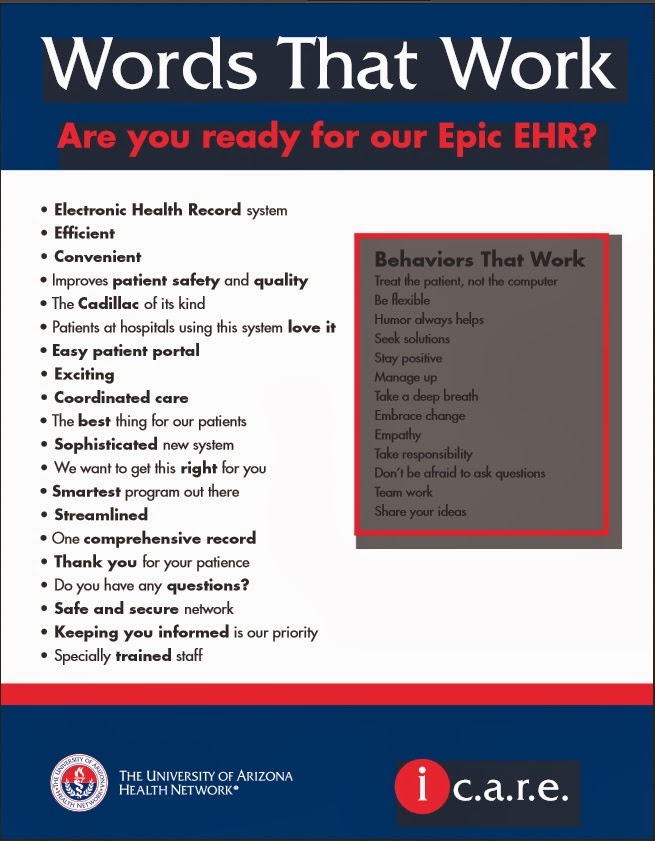

"Words that Work" - If I worked there, I would be concerned that that using "words that don't work" about a project that probably cost hundreds of millions of dollars would likely injure my career.  Click to enlarge.

This is shameless.  Many of these claims are unsubstantiated or in significant doubt in the literature.

First:

They left out issues such as these:

• The software is tested and validated for safety by nobody, including traditional medical device safety testers.

• No postmarket surveillance for problems, either.

• Transparency about problems that can cause patient harm is severely impeded by systematic impediments to information flow (as per IOM's 2012 study of health IT safety at http://hcrenewal.blogspot.com/2012/03/doctors-and-ehrs-reframing-modernists-v.html, FDA via their leaked Internal Memo on HIT safety as at http://hcrenewal.blogspot.com/2010/08/smoking-gun-internal-fda-memorandum-of.html, the Joint Commission in their Sentinel Events Alert on Health IT as at http://hcrenewal.blogspot.com/2008/12/joint-commission-sentinel-events-alert.html, and others.)

• Problems known are only the "tip of the iceberg" (FDA, ECRI Institute), as at http://hcrenewal.blogspot.com/2010/02/fda-on-health-it-adverse-consequences.html and http://hcrenewal.blogspot.com/2013/02/peering-underneath-icebergs-water-level.html

Of the claims they do make:

• Efficient - see aforementioned links as well as "Common Examples of Healthcare IT Difficulties" at http://cci.drexel.edu/faculty/ssilverstein/cases/

• Convenient - as above.  According to whom?  Compared to what?  Pen and paper?

• Improves patient safety and quality - see IOM report post at http://hcrenewal.blogspot.com/2011/11/iom-report-on-health-it-safety-nix-fda.html .  We as a nation are only now studying safety of this technology, and the results are not looking entirely convincing, e.g. ECRI Deep Dive Study of health IT safety at http://hcrenewal.blogspot.com/2013/02/peering-underneath-icebergs-water-level.html.  171 health IT mishaps in 36 hospitals, voluntarily reported over 9 weeks, with 8 reported injuries and 3 reported possible deaths is not what I would call something that "improves patient safety and quality" without qualifications.

• The Cadillac of its kind - according to whom?

• Patients at hospitals using this system love it -  Do most patients even know what it, or any EHR, looks like?  Have they provided informed consent to its use?

• Exciting - clinician surveys such as by physicians at http://hcrenewal.blogspot.com/2010/01/honest-physician-survey-on-ehrs.html and by nurses at http://hcrenewal.blogspot.com/2013/07/candid-nurse-opinions-on-ehrs-at.html shed doubt on that assertion.

• The best thing for our patients - again, according to whom?

• Sophisticated new system - "New"?  Not so much, just new for U. Arizona Health.  "Sophisticated", as if that's a virtue?  Too much "sophistication" is in part what causes clinician stress and burnout, raising risk; see this summary of a new, not-free JAMIA article "Electronic medical records and physician stress in primary care: results from the MEMO Study", J Am Med Inform Assoc amiajnl-2013-001875 at http://www.beckershospitalreview.com/healthcare-information-technology/the-relationship-between-emrs-and-physician-stress.html.   From that summary:

... Compared with physicians at clinics with low-function EMRs, physicians at clinics with moderate-function EMRs experienced significantly more stress and had a higher rate of burnout. Additionally, physicians at clinics with moderate- or high-function EMRs felt less satisfied with their current position overall.
and:
... Results also showed a significant relationship between time pressure and physician stress in the cohort with high-function EMRs, and only in this cohort, suggesting physicians at these clinics may be particularly pressured for time during patient encounters in the face of a large number of EMR functions. "This 'made sense' to us in thinking about the possibility that those in the high-use group had more to do in the EMR" [say the authors].

• Smartest program out there - "Smartest" meaning what, exactly?  According to whom?  Who performed the comparison?

• Streamlined - compared to what?

• Thank you for your patience - even if the effects on clinicians gets you or your loved ones maimed or killed?

• Safe and secure network - really?  No break ins, ever, considering multiple breach stories like those at http://hcrenewal.blogspot.com/search/label/medical%20record%20privacy?

• Keeping you informed is our priority - informed of what?

• Specially trained staff - like these:  http://hcrenewal.blogspot.com/2010/08/epics-outrageous-recommendations-on.html?

and this:

• Take Responsibility - I ask, should clinicians "take responsibility" for IT-related disruptions that impair care such as "use error" (as opposed to user error), i.e., what the National Institute of Standards and Technology has called operator error due to poor usability and other features of bad health IT?  (See "NIST on the EHR Mission Hostile User Experience" at http://hcrenewal.blogspot.com/2011/10/nist-on-ehr-mission-hostile-user.html.)  What about "glitches" and bugs that corrupt or lose data?  Should clinicians also 'take responsibility' for those?  (See for example the posts on the wild things that happen when IT malpractice leads to clinical mayhem at http://hcrenewal.blogspot.com/search/label/glitch.)

It appears to me that this vendor is using its client hospitals' management to enforce an "acceptable point of view" clinicians must proffer to patients about EHRs (which they must call "health" records), despite well-known contradictory findings.  This is, in effect, forced marketing of a device.

Trying that for a drug or a conventional medical device (e.g., a particular stent) would be on its face unethical and likely illegal.

Finally, critical thinking is what keeps patients alive and safe.  Marketing measures like this (some might call it "propaganda"), espousing and enforcing 'EHR exceptionalism', in my opinion, damage critical thinking and expression, and are thus unacceptable to push on clinicians and on patients.

I add that requiring clinicians to promote deceptive propaganda the clinicians themselves know is untrue, from painful experience, is degrading, intimidating and destroys morale.  It is axiomatic that clinicians (or anyone) operating under such conditions cannot perform at their best.

Thus the management geniuses who came up with these instructions (if not outright vendor-ghostwritten as at the Aug. 2012 "Health IT Vendor EPIC Caught Red-Handed: Ghostwriting And Using Customers as Stealth Lobbyists", http://www.tinyurl.com/epic-stealth) are by their actions increasing risk of patient harm.

The nurses' unions at at http://hcrenewal.blogspot.com/2013/07/rns-say-sutters-new-electronic-system.html have it right, in my view:  complain about the disruptions this technology causes, and complain loudly, if at the very least to make sure the problems are out in the open.

-- SS

Wednesday, August 28, 2013

Setback for Sutter after $1B EHR crashes (in followup to post "RNs Say Sutter’s New Electronic System Causing Serious Disruptions to Safe Patient Care at East Bay Hospitals")

At my July 12, 2013 post "RNs Say Sutter’s New Electronic System Causing Serious Disruptions to Safe Patient Care at East Bay Hospitals" (http://hcrenewal.blogspot.com/2013/07/rns-say-sutters-new-electronic-system.html) I reproduced a California Nurses Association warning about rollout of an EHR at Sutter:

RNs Say Sutter’s New Electronic System Causing Serious Disruptions to Safe Patient Care at East Bay Hospitals

Introduction of a new electronic medical records system at Sutter corporation East Bay hospitals has produced multiple problems with safe care delivery that has put patients at risk, charged the California Nurses Association today.

Problems with technology are not unique to health care ...  [What is unique to healthcare IT is the complete lack of regulation - ed.]

In over 100 reports submitted by RNs at Alta Bates Summit Medical Center facilities in Berkeley and Oakland, nurses cited a variety of serious problems with the new system, known as Epic. The reports are in union forms RNs submit to management documenting assignments they believe to be unsafe.

Patient care concerns included computerized delays in timely administration of medications and contact with physicians, ability to properly monitor patients, and other delays in treatment.  Many noted that the excessive amount of time required to interact with the computer system, inputting and accessing data, sharply cuts down on time they can spend with patients with frequent complaints from patients about not seeing their RN.  [Note: patients are not given the opportunity for informed consent about the risks, nor opt-out of EHR use in their care - ed.]

In related posts I'd observed such concerns being ignored by hospital management.  See header of the aforementioned post.

Now we have this:  a major system crash.

Healthcare IT News
Setback for Sutter after $1B EHR crashes
'No access to medication orders, patient allergies and other information puts patients at serious risk'
 
Worse, clinicians must now serve their Cybernetic Master to perfection, or be whipped (apparently to improve morale):

... "We have been on Epic for 5 months now, and we can no longer have incorrect orders, missing information or incorrect or missing charges. Starting on September 1st, errors made in any of the above will result in progressive discipline," according to another hospital memo sent to staff.

In the setting of dire warnings by the nurses of EHR dangers several months back that were likely largely ignored, if any patient was harmed or killed as a result of this latest fiasco, the corporate leadership has literally begged to be sued for negligence, in my view.

However I'm sure a press release soon will claim that "patient care has not been compromised."

Of course this includes now and moving forward, even with informational gaps all over the place.

-- SS

Aug. 29, 2013 additional thought:

The punishment for not being a 'perfect' user of this EHR is the ultimate "blame the user" (blame the victim?) game, considering the pressures of patient care in hospitals in lean times - partly due to EHR expense! - and EHRs that have not been formally studied for usability and are poorly designed causing "use error" (that is, a poor user experience promotes even careful users to make errors).  Cf. definition of bad health IT:

Bad Health IT ("BHIT") is defined as IT that is ill-suited to purpose, hard to use, unreliable, loses data or provides incorrect data, causes cognitive overload, slows rather than facilitates users, lacks appropriate alerts, creates the need for hypervigilance (i.e., towards avoiding IT-related mishaps) that increases stress, is lacking in security, compromises patient privacy or otherwise demonstrates suboptimal design and/or implementation.

The study of usability is getting underway only now via NIST but will likely be done in an industry-friendly way due to health IT politics.

-- SS

Aug. 29, 2013 addendum

There have been numerous comments over at HisTalk (at http://histalk2.com/2013/08/27/news-82813/) defending the outage as not EPIC's fault.   From the point of view of clinicians - and more importantly, patients - it doesn't matter what component of the hospital's entire "EHR" (an anachronistic term used for what is now a complex enterprise clinical resource and clinician command-and-control system) went down. 

Aside from all the EPIC issues the nurses have been complaining about (see earlier July 12, 2013 post linked above), the larger problem is that IT malpractice occurred.  The term "malpractice" is used in medical mishaps; I see no reason why it does not apply to major outages of mission critical healthcare information technology systems.

IT malpractice in healthcare kills.

These are the types of nurses I'd want caring for me and mine.  Letting this kind of snafu go "anechoic" does not promote proper management remedial education on Safety 101 and on health IT risk, two areas of education that management appears to desperately need in hospitals.

-- SS

Friday, July 12, 2013

RNs Say Sutter’s New Electronic System Causing Serious Disruptions to Safe Patient Care at East Bay Hospitals

Add the following from Sutter East Bay Hospitals to nurses' and physicians' complaints at Marin General Hospital (http://hcrenewal.blogspot.com/2013/05/marin-general-hospitals-nurses-are.html), Affinity Medical Center (http://hcrenewal.blogspot.com/2013/06/affinity-rns-call-for-halt-to-flawed.html), Contra Costa County (http://hcrenewal.blogspot.com/2012/08/contra-costas-45-million-computer.html), San Francisco Department of Public Health (http://hcrenewal.blogspot.com/2010/11/avatar-fails-no-not-cameron-movie-but.html), and others:

For Immediate Release 
July 11, 2013
Contact-  Charles Idelson, 510-273-2246

RNs Say Sutter’s New Electronic System Causing Serious Disruptions to Safe Patient Care at East Bay Hospitals

Introduction of a new electronic medical records system at Sutter corporation East Bay hospitals has produced multiple problems with safe care delivery that has put patients at risk, charged the California Nurses Association today.

Problems with technology are not unique to health care – pilots of the ill fated Asiana airline that tragically crashed at San Francisco International Airport July 6 told federal investigators that an automatic throttle failed to keep the jetliner at the proper speed for landing, the Los Angeles Times reported July 9.  [What is unique to healthcare IT is the complete lack of regulation - ed.]

In over 100 reports submitted by RNs at Alta Bates Summit Medical Center facilities in Berkeley and Oakland, nurses cited a variety of serious problems with the new system, known as Epic. The reports are in union forms RNs submit to management documenting assignments they believe to be unsafe.

Patient care concerns included computerized delays in timely administration of medications and contact with physicians, ability to properly monitor patients, and other delays in treatment.  Many noted that the excessive amount of time required to interact with the computer system, inputting and accessing data, sharply cuts down on time they can spend with patients with frequent complaints from patients about not seeing their RN.  [Note: patients are not given the opportunity for informed consent about the risks, nor opt-out of EHR use in their care - ed.]

"EPIC is a system that is so cumbersome to use for nurses and physicians, that we often feel as though we are caring for a computer, not a patient,” said Thorild Urdal, an RN at Alta Bates Summit’s hospital in Berkeley. “It delays care and treatment, the program is naturally counter-intuitive and it was clearly not designed in concert with nurses and physicians." [Clinicians end up caring for an "iPatient", as others have noted - ed.]

"The Epic program developed and implemented by Sutter is neither nurse or patient friendly,” said Alta Bates Summit Oakland RN Mike Hill. “Epic does not enhance my ability to chart instead it takes time away from the bedside and my patients and preventing me from providing the absolute best care that they and I expect from me as a nurse."

Sutter CEO Pat Fry last year told the San Francisco Business Times that Sutter will spend $1 billion on Epic, a system that has sparked controversy at several other hospitals, including a Contra Costa facility where several RNs cited serious medical errors in testimony to county supervisors last August.

At Alta Bates Summit specific incidents directly related to Epic problems included:

• A patient who had to be transferred to the intensive care unit due to delays in care caused by the computer.  [It's happenstance they did not have to be transferred to the morgue - ed.]
• A nurse who was not able to obtain needed blood for an emergent medical emergency.
• Insulin orders set erroneously by the software.
• Missed orders for lab tests for newborn babies and an inability for RNs to spend time teaching new mothers how to properly breast feed babies before patient discharge.
• Lab tests not done in a timely manner.
• Frequent short staffing caused by time RNs have to spend with the computers.
• Orders incorrectly entered by physicians requiring the RNs to track down the physician before tests can be done or medication ordered.
• Discrepancies between the Epic computers and the computers that dispense medications causing errors with medication labels and delays in administering medications.
• Patient information, including vital signs, missing in the computer software.
• An inability to accurately chart specific patient needs or conditions because of pre-determined responses by the computer software.
• Multiple problems with RN fatigue because of time required by the computers and an inability to take rest breaks as a result.
• Inadequate RN training and orientation.

These "incidents" are certainly capable of causing harms or fatalities.  One wonders if hospital executives are providing the usual refrain that these are just "glitches" (http://hcrenewal.blogspot.com/search/label/glitch) and that patient care has not been compromised (http://hcrenewal.blogspot.com/search/label/Patient%20care%20has%20not%20been%20compromised).

A bit more background follows:

... Hospitals nationally are spending tens of billions of dollars on technology systems, especially on electronic health records (EHR) programs for which they also receive federal financial incentives.

EHR programs are paraded as a panacea for reducing medical errors and cutting costs, but in life the promise is falling short in both areas.

A RAND corporation analysis earlier this year said visions of savings and improved efficiency in patient care have had what the New York Times called “mixed results, at best.”

The U.S. Food and Drug Administration has acknowledged getting hundreds of reports of problems involving health information technology including numerous patient injuries and deaths.

Some examples seen at hospitals across the country:

• At Marin General Hospital in Northern California, RNs called on the Marin Healthcare District board to delay implementation of their EHR system. "Orders are being inadvertently passed to the wrong patients. People have gotten meds when they've been allergic to them. This is dangerous," Marin RN Barbara Ryan said in comments reported by the Marin Independent Journal.
• In Chicago, the Chicago Tribune in 2011 reported on a patient death at Advocate Lutheran General hospital after an automated machine prepared an intravenous solution containing a massive overdose of sodium chloride — more than 60 times the amount ordered by a physician.
• At Affinity Medical Center RNs in Massillon, Oh. RNs in June raised multiple objections to the hurried introduction of an EHR system. Subsequently, they have cited medication errors, delays in care, problems with documentation, computers crashing, and other concerns.

I am simply the reporter here.

-- SS

Friday, May 10, 2013

Clouded "Visionary" Leadership - Wake Forest Baptist Medical Center's EPIC "Business Cycle Disruptions"

A typical excuse for the multi-million dollar compensation now enjoyed by many leaders of health care organizations is these leaders' supposed brilliance.

For example, in 2011 we noted  that the total compensation of Dr John McConnell, the CEO of Wake Forest Baptist Medical Center, a non-profit teaching hospital, rose from over $700,000 in 2008-2009 to over $1.6 million in 2009-2010.  Other top executives in the system made nearly one million a piece.  An official statement from the hospital system claimed that this level of compensation was needed to "retain skilled executives and visionary leaders for the medical center."  Furthermore, in 2012 we noted that in 2010-2011 Dr McConnell's compensation had grown to nearly $2.5 million, while other top executives received from over $900,000 to over $1.1 million. 

Recent events, however, suggest that the "visionaries" may need new glasses.

An EPIC Challenge

Last month, the Winston-Salem Journal reported that Wake Forest Baptist Medical Center is facing some unexpected fiscal challenges, especially from its new electronic health record (EHR):


Wake Forest Baptist Medical Center’s struggles to implement its Epic electronic records system contributed to additional costs and lost revenue during the first half of its fiscal year 2012-13.

The center provided the information in a second-quarter financial report submitted to bond agencies in which it also reported a $49.6 million operational loss and a gain of $7.4 million in overall excess revenue.

That is interesting.  There have been many criticisms of EHRs, particularly for how they may impede, rather than help health professionals, and more importantly for their risks of causing adverse effects affecting patients, in the absence of clear data from controlled clinical trials that they provide benefits that outweigh their potential harms to patients.  Some of these problems may stem from design and implementation that prioritizes benefits to managers and institutional finances over effects on patients and doctors.  As InformaticsMD noted, even the AMA now admits that

 As the healthcare industry moves to EHRs, the medical record has essentially been reduced to a tool for billing, compliance, and litigation that also has a sustained negative impact on doctors' productivity, according to Steven J. Stack, MD, chair of the American Medical Association’s board of trustees.

Yet in this case, a well known commercial EHR did not even help out the hospital system's finances.

Furthermore,

Wake Forest Baptist said it spent as of Dec. 31 about $13.3 million directly on the Epic electronic-record system, which went live in September.

And,

 The center also cited $8 million in 'other Epic-related implementation expense' that it listed among 'business-cycle disruptions (that) have had a greater-than-anticipated impact on volumes and productivity.' Also listed was $26.6 million in lost margin 'due to interim volume disruptions during initial go-live and post go-live optimization.'

Note that InformaticsMD frequently criticizes proponents of commercial health care information technology for glossing over potentially bad effects on patients and practice with management-speak (e.g., as "glitches," or "hiccups.").  Here is a great example of an attempt to gloss over bad effects on finance with management-speak.

Bond Downgrades and Furloughs, Wage Reductions, Hiring Freezes, Retirement Contribution Reductions, and Bonus Eliminations

As a consequence,

 On March 20, Moody’s Investors Service downgraded the center’s long-term debt rating below the lowest level of high-grade investment quality. The downgrade to A1 from Aa3 affects $597.2 million of rated debt outstanding.

The rationale was clear,

 Moody’s said the A1 rating 'reflects the unexpected decline in financial performance through the first half of fiscal 2013, largely due to the installation of a new information technology platform (Epic), encompassing 95 percent of all revenue components of the enterprise.'
You know when you see bond downgrade by rating agencies that  financial matters are really going badly.  

By May, 2013, month, the problems were evidently still not solved, and the hospital was forced to take more drastic measures.  As again reported by Richard Carver writing for the Winston-Salem Journal,


The workforce at Wake Forest Baptist Medical Center is paying a paycheck price to make up for the financial shortcomings to date of its Epic electronic records system.

The center said in a statement Thursday it has begun another round of cost-cutting measures that will last through at least June 30, the end of its 2012-13 fiscal year.


The measures include attempts at volunteer employee furloughs and hour-and-wage reductions, a hiring freeze, a reduction in employer retirement contributions, and elimination of executive incentive bonuses for 2013.


Management made clear that the cuts were in response to the Epic debacle,


Even though management said Thursday the center is making progress with fixing the Epic revenue issues, it acknowledged it 'will not meet projected financial targets for the current fiscal year.'

'Wake Forest Baptist has identified immediate multimillion-dollar savings with a series of short-term measures that impact personnel,' according to the statement.

To give credit where it is due, at least the cuts will apparently not affect line clinical employees:

 Those primarily affected by the volunteer furloughs and hour-and-wage reduction requests are nonclinical full-time employees, including administrative staff. They can volunteer to work as few as 30 hours a week with no loss of health or dental benefits for May and June. In the memo, management said employees can volunteer to continue the reduced-hour work week into fiscal year 2013-14.

However, it seems likely that they will affect many employees, including some proportion who likely had not responsibility for the problems with Epic.

When in Doubt, Lobby the Government

What the hospital system did not seem to be cutting was lobbying and public relations.  Perhaps this was a response to its unexpected inability to manage its own commercial health care information technology?  What bad management can lose, maybe government can supplant.  Once again Richard Carver had the story for the Journal:


Stung by a series of unusual setbacks at the General Assembly, the North Carolina hospital industry is launching a public relations campaign aimed, in part, at protecting revenues and staving off competition from lower cost surgery centers.

In a social media initiative targeted at lawmakers and their constituents, the N.C. Hospital Association says hospitals are 'fighting for their economic survival.' [It was not said whether they were fighting in part because they had already managed to shoot themselves in their economic feet - Ed]


The association and some of the state’s bigger hospitals also are hiring more GOP lobbyists to make inroads with the Republicans who control the state House, Senate and governor’s mansion.

The hospital association recently began promoting a new website — www.healthyhospitalsnc.org — that describes an array of financial threats.

Wake Forest Baptist is a big part of this initiative:

When asked about its lobbying efforts, Wake Forest Baptist spokeswoman Paula Faria said last week that the center’s Office of Government Relations monitors proposed legislation and regulations at both the federal and state levels.

'It informs North Carolina’s congressional delegation, members of the General Assembly and their staff about how proposed language could impact the day-to-day operations of the medical center.'

Maybe they should be first worrying about the impact of badly chosen, designed, or implemented commercial health care information technology on "day-to-day operations of the medical center" first.

 Summary

So the top executives of Wake Forest Baptist Medical Center have seen compensation rising at a rate greater than inflation and than the general public's income over the last few years.  In particular, the CEO has seen his compensation go up three and one-half times in three years!  The hospital system administration has justified this extraordinary increase by referring to supposedly "visionary" leadership.  Yet over this time frame these "visionaries" decided to implement an EHR whose first effects were to lose the hospital system a lot of money.  Based on previous anecdotes about the Epic system, it is quite possible it had other adverse effects.  For example, InformaticsMD discussed a case in which an EPIC system apparently lead to a large disruption in patient workflow and hence large increases in waits for acute care, and lead to errors that could have adversely affected patients.  So this underscores some important lessons:

So beware that "visionary" behind the curtain. As we have noted repeatedly, top health care managers can now easily make themselves rich.  They, their boards of directors (who may be their cronies), and their public relations flacks often justify their exorbitant compensation by their supposed brilliance, if not visionary status.  Such claims are rarely further explained, and mostly seem be be humbug, for want of a better term.  It seems that most top leaders of health care organizations have participated in the managers' coup d'etat, and become at least manager nobility, if not manager-kings  At least, the public should know that their compensation is what they can grab, and its justification is often nonsense. 

Note that contrary to a red herring argument often made, outrageous compensation is important not so much because of how much money it drains out of health care, although that can be large in the aggregate.  It is important because it reflects a system that is no longer accountable, and leaders who follow perverse incentives.

Such management compensation is almost never revisited to determine whether it turned out to be justified.  Instead, the public, watchdog organizations, health care professionals, and even politicians ought to demand accountability of health care management, good  justification for their compensation, and rationality for the incentives they are provided.  True health care reform would encourage well-informed, competent, mission-focused, honest, responsible, accountable and transparent management, leading organizations of manageable size.  But as long as things stay the same, expect the craziness to continue.   


Saturday, May 4, 2013

Financial woes at Maine Medical Center: Reading this blog might have saved them millions of dollars, and prevented massive "cost saving initiatives"

In this article, the euphemistic and almost endearing term "hiccup" is used instead of the more traditional "glitch" to describe obvious major information technology malfunctions.  It is likely the knowledge at this blog and at my health IT dysfunction teaching site could have helped prevent most of these problems:

Financial woes at Maine Medical Center
New England health system facing $13 million loss, initiates plan to save $15 million
NEW GLOUCESTER, ME | May 2, 2013

In a memo to its employees last week, one of Maine’s largest health systems said it has suffered an operating loss of $13.4 million in the first half of its fiscal year.

“Through March (six months of our fiscal year), Maine Medical Center experienced a negative financial position that it has not witnessed in recent memory,” Richard Petersen, president and CEO of the medical center, wrote in the memo to employees. A copy of the memo was sent to MedTech Media, publisher of Healthcare Finance News.

A "negative financial position" (translation: we lost big money) that it has not witnessed in recent memory?  What are the reasons?

In order to bring the medical center to breakeven by year’s end, the health system’s leadership has determined $15 million needs to be saved.

In the memo, Petersen said the operating loss is due to declines in inpatient and outpatient volumes because of the hospital’s efforts to reduce readmissions and infections; “unintended financial consequences” due to the roll out of the health system’s Epic electronic health record and problems associated with being unable to accurately charge for services provided; an increase in free care and bad debt cases; and continued declining reimbursement from Medicare and MaineCare, the state’s Medicaid program.

That rings a familiar tune - from the mid 1990's at Yale, as well as more recently.

Many of the reasons for Maine Medical’s financial woes are similar to those hospitals across the country are facing.

A recovering national economy, continued budget restrictions and restraint and the realization that, while electronic health records may have efficiencies and cost savings over time, the costly transition to EHRs may take years to recoup.


Especially when not done well.

In his memo to employees, Petersen said the hospital has identified many of the hiccups contributing to the charge capture problems and a team of hospital employees and Epic technicians are working to resolve those issues. In the meantime, the remaining roll out of the Epic EHR to the rest of the health system is on hold.

Hiccups? Health IT has a euphemistic language all its own.  Only apostates would dare to call the "hiccups" for what they really are, in medical parlance:  IT malpractice.

To save $15 million by year’s end, Maine Medical is immediately instituting a number of cost-saving initiatives including selective travel and hiring freezes, putting the operating contingency budget on hold and reducing overtime. Petersen appealed to employees to curb discretionary spending and contact management with any cost-saving ideas.

All, of course, will have no impact on patient care....

“I’m confident that we’ll confront this test, beat back the issues we face, and reverse this negative financial picture,” Petersen wrote in the conclusion to the memo.

Test?  Test of what, IT competence?

Of course, "C" officers would never write that "I'm not confident we'll confront our screwups."

Maine Medical did not reply to an interview request by deadline. The Maine Hospital Association declined to comment for this story.

Silence is golden.

A newspaper letter from Stuart Smith, Selectman, Town of Edgecomb, St. Andrews Regional Task Force (a software developer himself) tells more:

STUART SMITH'S LETTER TO THE REGISTER
Wednesday, May 1, 2013 - 7:30pm
Save St. Andrews Hospital

As the Boothbay Peninsula moves forward with the effects of a MaineHealth/Lincoln County HealthCare decision to close St. Andrews Hospital, I have served on the 4 Town Regional Task Force. This has been an unprecedented cooperation between 4 towns in this region that has generated many continuing activities that will benefit all towns in our region.

Apparently an entire hospital is closing as a result of these debacles.

[May 8, 2013 addendum: a family physician in Lincoln County where St. Andrews hospital is located and a member of the Board of Trustees, Dan Friedland, M.D., writes me that the EHR had nothing to do with the hospital closing - ed.]

But let me get back to the MH/LCH decision. We are told that MaineHealth has spent over $150 million on an Electronic Medical Records (EMR) system that helps all of its “subsidiaries.” I can appreciate this because my work is in software development.

I do question the $150 million figure. I think it is extremely high and Portland has had a real failure in its implementation. So much so that it looks like LCH will not have a real integrated EMR until 2015 and financial software problems exemplify a major failure of MH to create any real benefit to the State. Millions of dollars have been charged to member hospitals and staff time (salaries and mileage) over the past 2-3 years with no benefit.

I'd questioned the high cost of these commercial EHR systems as far back as 2006 ("Yet another clinical IT controversy: UC Davis" and "External oversight needed for hospital EMR implementation?" - Lancaster General Hospital and "$70 million for an Electronic Medical Records system [quasi endpoint]?- Geisinger).

One might think healthcare systems have money to burn ...

The system failure also adds operational costs going forward that were not planned for and regional consolidation of finance will now be delayed. The cost to Maine Health Center is huge in improper service and supply charges. Information Technology leadership has been fired, but MH administration is truly accountable.

For once, someone in IT leadership did not get a a promotion for failure.  It is true that MH administration is accountable, however - they had the fiduciary responsibility to hire the best talent, and to oversee that talent as needed to assure success.  If "C" leadership didn't understand IT, that's their failure as well.  In my view in 2013 everyone in a position of organizational responsibility should have a good understanding of IT, which is now, after all, a commodity.

I'm hopeful EPIC, with its apparently revolutionary hiring practices akin to the hiring of physicians, will have the "hiccups" fixed in no time.  From this link at the "Histalk" site on staffing of health IT projects, Aug. 16, 2010. Emphases mine:

Epic Staffing Guide

A reader sent over a copy of the staffing guide that Epic provides to its customers. I thought it was interesting, first and foremost in that Epic is so specific in its implementation plan that it sends customers an 18-page document on how staff their part of the project.

Epic emphasizes that many hospitals can staff their projects internally, choosing people who know the organization. However, they emphasize choosing the best and brightest, not those with time to spare. Epic advocates the same approach it takes in its own hiring: don’t worry about relevant experience, choose people with the right traits, qualities, and skills, they say.  The guide suggests hiring recent college graduates for analyst roles. Ability is more important than experience, it says. That includes reviewing a candidate’s college GPA and standardized test scores.


I am forwarding links to this post, blog, my teaching site (begun in 1998) and additional material to Selectman Smith.

I'd offer to help, but the management of the organization would likely find, as did management at this one (a major denominational chain), that I have too much experience for the organization.

-- SS