Showing posts with label Twitter. Show all posts

Thursday, September 12, 2013

#NotDeadYet: Slate Sparks An Awesome Online Discussion of Life, Medicine, and Public Health


Last Thursday Slate, a daily web magazine, kicked off a series on life expectancy.  I highly recommend taking the time to read the articles, which cover everything from notable public health advances to improving maternal/child health outcomes.  I was very pleased to see many public health organizations sharing these articles with their followers.


While the content was enough to draw me in, I was particularly intrigued by the online dialogue that was sparked by this series.  Over the past week, my Twitter feed has been filled with colleagues participating in the discussion using the hashtag #NotDeadYet.  In the series' first post, "Why Are You Not Dead Yet?", Laura Helmuth explores why life expectancy has doubled in the past 150 years.  At the end of the post, Laura asked readers to send their #NotDeadYet survival stories to Slate's twitter or email accounts.  A selection of the submitted stories ran today to wrap up the week-long series on life expectancy.

With so many newspapers and blogs (mine included) heavily depending on the comment section to initiate discussion, I was intrigued by the idea of starting an accompanying Twitter hashtag thread.  Impressed by the high participation rate just on my own feed, I reached out to Laura Helmuth to gather more information about her dialogue with readers.  She was very gracious to respond to my questions during what I assume has been a very busy week with the series!    

She shared that Slate received more than 200 emails from people sharing their stories (some of them quite elaborate). They also received about 800 responses on Twitter.  In terms of story content:

  • About a quarter of the emails concerned childbirth- women who would have died giving birth and people who would have died when they were born. 
  • Many of the Twitter messages were also about childbirth, including a lot of men who tweeted that they would be childless widowers right now if it were not for modern medicine. 
  • Slate also heard from a lot of people who survived a burst appendix. Lots of people were saved from nasty infections by antibiotics. And some had gruesome accidents that were patched up in surgery. Lots of people have had heart surgery. Many people credited their anti-depressants for keeping them alive. A surprising number mentioned that they were treated with antivenins for snakebite! 

Laura noted that this hashtag thread was especially heartwarming because "people were taking a moment to share their scariest stories and express gratitude that they’re ALIVE".  She also said that "it’s a great reminder that so many of the people we know would be dead if it weren’t for treatments we sometimes take for granted". A big thank you to Laura for sharing these responses and her reactions!

After putting this post together, I have two messages- one about the content and one about the strategy that Slate used for communicating this story.  
  • (1) It is important to look back and inventory the medical and public health advances that we take for granted.  Last year I wrote about the wonderful Frontline documentary, "The Vaccine War".  When discussing fears of vaccination and the decrease in childhood vaccination rates, the documentary noted that this new generation of parents are too young to know the devastating effects of vaccine-preventable diseases like polio.  One interviewee used a term that I really like- "Community Recollection".  As Community Recollection of these diseases disappears, we can become complacent.  We are seeing the devastating results of this complacency with outbreaks of preventable disease (for example the outbreak of Measles just a few weeks ago in Texas). 
  • (2) We in public health should take note and learn from the strategies that Slate has used to engage readers.  We are always looking for ways to initiate conversation beyond the articles we publish or the classes we teach or the webinars or twitterchats that we facilitate.  A few observations:
    • The hashtag thread allowed them to take the discussion beyond the comment section onto Twitter.  
    • Hashtags are easily searchable, so new participants could quickly be gained that did not originally follow or read the magazine.  
    • The hashtag #NotDeadYet was innovative and "catchy" not boring like #PublicHealthAdvances.  
    • Readers also had an incentive to share their stories, since Slate was selecting the top 50 to wrap up the series.   
I'd love to hear from my readers!
  • Did you read the Slate life expectancy series?  Reactions to share?
  • Have you tried similar strategies to engage readers with the content that you distribute?  Success stories or lessons learned to share?

Tuesday, July 23, 2013

#RoyalBaby Offers Public Health A Unique Opportunity To Advocate For Maternal and Child Health

As Catherine, Duchess of Cambridge, went into labor early yesterday morning, public health organizations and advocates took advantage of the opportunity to talk about maternal and child health.  Since much of the world was following the #RoyalBaby story, it made sense to make the connection to public health work.


Here are some of my favorite tweets and topics:

VACCINATIONS


 NEWBORN SCREENING

BREASTFEEDING


Andy's tweet was in response to this image from Oreo:


PRENATAL SMOKING


SUPPORT FOR NEW PARENTS


As I've noted in related posts, I hope these organizations are evaluating their communication strategies!

  • Have they seen an increase in traffic to their websites and resources?
  • Have they engaged a new audience by aligning with the #RoyalBaby news?
  • What organizational resources are needed to develop communication plans that coordinate with timely global and pop culture news?
  • What lessons learned can be applied to future communication efforts? 
What do you think?
  • Are these types of communication strategies effective in reaching a broader audience?
  • Are there other relevant public health tweets that you felt were creative and engaging?  Please share!!

Monday, April 8, 2013

Social Media: Providing Connections, Voices, Adventures to Many with Chronic Illness

I am in awe of social media.  

I am in awe of it in my professional life.  I have connected with colleagues all over the world who share my passion for public health, health communication, blogging, pop culture- you name it.

I am also in awe of it in my personal life.  As someone who lives with a chronic illness, I have connected with others who suffer from similar symptoms, offer support, advocate for patient rights, and recommend creative solutions to balancing work and life.

In the past month, I have been struck by several examples of how social media is transforming the lives of people with chronic illness.  Without the networks available within social media, many of these people may have been very isolated due to their conditions.

On March 11, 2013 NBC Nightly News with Brian Williams ran a story about Virtual Photo Walks.  The project's tagline is "Walk the walk for those who can't".  Using the social media platform Google+, Virtual Photo Walks enables people to become "interactive citizens" again.  They connect with smart phone enabled photographers to "travel" and see places and people that they used to see...or always wished that they could.  The news story profiled a woman with Lupus who could not travel due to her serious health condition.  She always wanted to go to Italy and with Google+ she did.  We watched World War II veterans no longer able to travel, "visit" the USS Arizona Memorial through the collaboration of photographers and Google +.  It was incredible to watch.    

On April 5, 2013 CNN Tech ran a story called "On Twitter, Roger Ebert Found a New Voice".  The story describes how Roger became an avid twitter user in 2010, years after cancer had silenced his voice.  He wrote, 

"Twitter for me performs the function of a running conversation. For someone who cannot speak, it allows a way to unload my zingers and one-liners".

As someone growing up in the 80's, I regularly watched "Siskel and Ebert and the Movies".  Keeping up with Roger through twitter and his blog "Roger Ebert's Journal" in recent years has been a seamless transition.  I felt like the show never ended.  I kept up with his running commentary and of course- his movie reviews.

Sustaining your presence in the world is important with a chronic illness.  I felt that point strongly when reading his final blog post, "A Leave of Presence".  

"What in the world is a leave of presence?  It means I am not going away".  


Please Share:
  • What creative ways do you see social media being used to support those with chronic (or acute) illnesses?
  • Why do you think these communication channels are so effective in "sustaining your presence"?

Friday, March 8, 2013

Twitter EHR "revolt": #EHRbacklash

As noted at the new IEEE Spectrum piece "U. S. Electronic Health Record Initiative: A Backlash Growing?"  (worth reading in its entirety along with its hyperlinks), the following is noted:

There seems to be a slow but steady backlash growing among healthcare providers against the U.S. government’s $30 billion initiative to get all its citizens an electronic health record, initially set to happen by 2014 but now looking at 2020 or beyond. The backlash isn’t so much about the need for, or eventual benefits of, electronic health records but more about the perceived (and real) difficulties caused by the government's incentive program and a growing realization of the actual financial and operational costs involved in rolling out, using, and paying for EHR systems.

The first hyperlink (on the word "backlash") is to a Twitter "revolt" marked by tweets using the hash tag (index tag) "#EHRbacklash." 

I did not start the use of this tag, although have started "tweeting" using it.

The link to tweets made with the tag is:  https://twitter.com/search?q=%23EHRbacklash&src=hash

This is certainly a "first", and should be an industry and pundit wake-up call.

-- SS

Addendum:  easier to follow at this link:  http://tweetchat.com/room/EHRbacklash

Tuesday, March 5, 2013

Using Twitter to Track Disease: Weighing the Advantages and Challenges


A few weeks ago I participated in a fantastic twitter chat on the use of social media for public health.  During the event, our moderators posed the following question: "Are there any other diseases (besides the flu) that we could track on social media?"

The question generated a very lively discussion that I was inspired to revisit on Storify this morning after reading the Washington Post's article, "Twitter becomes a tool for tracking flu epidemics and other public health issues." 

The WP article highlights several advantages and challenges of monitoring public health diseases and/or conditions on twitter.  My twitter chat colleagues brought up many other important issues for us to consider, so I'm including these expanded lists:

Advantages:


Challenges:

  • Accuracy and case definition (i.e., does a twitter user really have the flu or just a bad cold?)
  • Tracking specific words like "sick" or "flu" can bring up a lot of content that is unrelated to the twitter user being ill themselves (e.g., "I'm so sick of this terrible weather").  *Check out how Johns Hopkins researchers are working to address this problem by better screening tweets.
  • We must differentiate between tracking symptoms vs. tracking cases- they are not the same.
  • Our search strategies should include various terms or slang that are used to describe the disease or behavior of interest.
  • Caution: media coverage of certain illnesses can cause a spike in key words on twitter without a rise in actual cases.
  • What are the privacy concerns?
  • Twitter might not thoroughly capture diseases or conditions that carry stigma (e.g., mental illness) because users may be hesitant to discuss them in a public forum.
  • Results could be skewed by populations who are over or under represented on twitter.
  • Do we need to train "trackers" to intervene? E.g., what if they are monitoring dangerous tweets/behaviors like suicidal ideation and attempts?
While the challenges list is quite long, I hope we are not discouraged!  I think twitter is an enormous resource for public health professionals.  We just need to be thoughtful and thorough regarding how to use twitter effectively.

More Resources:

The Washington Post article and related stories shared great links to more information about research in this area:
What Do You Think?
  • What other advantages and/or challenges should we add to the list?
  • What other resources can you share?
  

Wednesday, May 9, 2012

So Who Else Caught the Brain Surgery on Twitter Today?

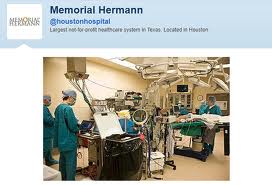
If you were on twitter today, you may have seen the hashtag #MHbrain.  That stood for Memorial Hermann-Texas Medical Center in Houston (@houstonhospital).  Today they live-tweeted a brain surgery which removed a cavernous angioma tumor from a 21-year-old female patient.

According to the hospital's press release, the goal of the "twittercast" was to (1) educate the public about brain tumors and (2) demystify brain surgery by giving a look inside an operating room.  The surgeon, Dr. Dong Kim, added "Someone may have a loved one who is considering a similar procedure and perhaps they can glean some information from this twittercast that may help them make a decision about whether surgery is the right choice for them."

In authentic social media style, the hospital did not just send out information and images. They also had another neurosurgeon, Dr. Scott Shepard, serve as an online moderator who could respond to questions and comments from twitter followers in real time.

While there was much excitement over this event today, it is not the first time we have heard about surgeons tweeting from the operating room.  Back in 2009, CNN picked up a story about surgeons at Henry Ford Hospital in Michigan tweeting the removal of a cancerous tumor from the kidney of a male patient.  Just last February, Memorial Hermann was in the news for the first live tweeted open heart surgery.

A few thoughts on this trend:

How is Memorial Hermann evaluating their twittercast efforts?  
  • Was this a huge marketing event or do they actually have health education goals?
  • Are they simply looking at the numbers?  For example, the number of twitter followers (up to 13,400 from 5,100 in the past 3 months).  Or the number of visitors to Storify, a site which archives both the heart and brain surgeries.
  • Are the demographics of twitter users reflective of their target audience?
  • I would hope that they are thinking about how to evaluate the goals they explicitly laid out in their press release.  How will they show that a twittercast can increase knowledge about brain tumors?  How will they show that the public or potential patients have less anxiety about the procedure or choose it more often?  As always, it is important to state goals (for any public health activity) that are measurable.  
How is social media a benefit/challenge for physicians?
  • I read an interesting blog post recently called, "Why social media may not be worth it for doctors."  The author was concerned about already burned-out doctors trying to learn and make time for ever-changing technology...with no guarantee that the technology will give them "return on investment".  Do the challenges outweigh the benefits?
  • If physicians view themselves as "educators", how much value could twitter bring?
Are there patient safety or confidentiality issues that should be considered?
  • Although the patient's name was protected and she gave permission for the twittercast, is it possible that any confidential information could be accidentally shared during the event?
  • Although safeguards are in place, errors do happen in the operating room and throughout the hospital.  With the additional staff/equipment (and possible distraction?) in the operating room to conduct the twittercast, could we face an increased risk of error?
What do you think?

Wednesday, March 28, 2012

"Hashtag Activism"- Is It Working For Public Health?

Last year on Facebook, my timeline was suddenly filled with status updates of just one word.  Red. Black. White.  "What is this?" I thought to myself.  It turned out that it was a breast cancer awareness campaign.  Facebook users were listing their bra colors to help prevent breast cancer.  And there are tons of these public health campaigns all over social networking sites.  "Like" our Facebook page to prevent cancer!  "Re tweet" this message to prevent heart disease!  For those of you familiar with my blog, you'll remember that I think "raising awareness" is the most counter-productive phrase used in our work.  It is not specific enough to measure for change and (on its own) it will not change health behaviors.  

So I thought of my frustration with these campaigns as I read a great article in the New York Times this week called, "Hashtag Activism, and Its Limits".  David Carr writes eloquently about the ease of supporting a variety of causes:

"If you “like” something, does that mean you care about it?  It’s an important distinction in an age when you can accumulate social currency on Facebook or Twitter just by hitting the “like” or “favorite” button.

The ongoing referendum on the Web often seems more like a kind of collective digital graffiti than a measure of engagement: I saw this thing, it spoke to me for at least one second, and here is my mark to prove it".

I like that David brings up the question of engagement here.  Many of these public health campaigns on social media just strive for "likes" on Facebook or "hits" on a website or "re tweets" on Twitter.  And not that they mean nothing, but those measures are just the tip of the iceberg in measuring audience engagement.  And audience engagement (beyond "raising awareness") is what could actually lead to public health activism, knowledge change, and ultimately behavior change. Leslie Lewis gives a great overview of Return on Engagement (ROE) on her blog "digital.good".  According to Leslie, ROE measures tend to be more qualitative and measure message reach and spread.  In addition to "likes", ROE also measures things like brand/campaign awareness, comments, shares, and returning visitors. 

I certainly do not think that all public health campaigns delivered via social media are ineffective.  On the contrary, I think that social media is an incredibly powerful tool for public health.  David Carr makes similar comments later in his article.  Challenging his initial skepticism of web activism, he lists several recent "campaigns" that have been quite effective (e.g., the reversal of Susan G. Komen de-funding Planned Parenthood).

However, to use social media effectively in public health, we must be strategic and we must evaluate.  

Some sample questions that I ask program planners:
  • What is the goal of the campaign?  (e.g., to drive traffic to your website; increase hotline calls; increase specific behaviors like breast self examination?).
  • How will the campaign activities (logically) lead to the desired goal/outcome?
  • Are your goals/outcomes measurable?
  • Have you thought about evaluation before launching the campaign?
  • Besides the ideas listed above, how are you measuring "audience engagement"?
 
 What other questions should we be asking?

Wednesday, October 26, 2011

Miami Dolphin Brandon Marshall's New PSA for Borderline Personality Disorder

In July 2011, Brandon Marshall revealed that he was diagnosed with Borderline Personality Disorder (BPD). According to the National Education Alliance for Borderline Personality Disorder, this serious mental illness centers on the inability to manage emotions effectively. The condition which has strong heritability (68%) and a high suicide rate (10% of adults with BPD die by suicide), produces symptoms such as impulsivity, anger, and chaotic relationships.

When Brandon announced his condition this summer, he vowed to become the face of borderline personality disorder. He seems to be following through on his promise, as he has just released a public service announcement (PSA) in collaboration with the National Education Alliance for Borderline Personality Disorder. The 33-second video is primarily focused on 3 key messages:

1. Prevalence of this condition is high (15 million Americans)
2. There is hope (treatment exists for those who suffer and education exists for families coping with the disorder)
3. There are resources: visit the NEABPD website or follow Brandon on Twitter (@BMarshall19) for more information

I like the PSA for several reasons. It is simple with clear messages (above). The messages are delivered both verbally by Brandon and visually with key words appearing on the screen. The "call to action" is clear. Viewers are directed to the NEABPD website and Brandon's Twitter feed for more information.

I also like that this particular health issue has found a champion or spokesperson. Unlike other mental health conditions like depression with several celebrity spokespeople (e.g., Brooke Shields), less is known about BPD and those who suffer from it. Experts in mental illness stigma like Patrick Corrigan state that there are several strategies for reducing stigma...and one of those strategies is called "Contact". Contact challenges public attitudes about mental illness through direct interactions with persons who have these disorders. The contact does not have to be face to face, but instead can occur through a channel like a PSA.

The strategies that I see for improving this PSA are focused less on its composition, but instead on its distribution/promotion. Although the video has been on YouTube for 6 days, it only has 309 views. Announcements about the PSA are located primarily on football blogs (e.g., Shut Down Corner) or BPD specific websites. It does not seem that the PSA has been picked up by mainstream media or health blogs. This is in sharp contrast to PSAs I've spoken about previously on Pop Health, like in July 2011 when I discussed Kim Kardashian's ovarian cancer research spot which currently has 33,431 views.

Readers- please weigh in: which mental health advocacy organizations would have the best "reach" in promoting this PSA? What other strategies could they use for distribution/promotion?

Sunday, October 9, 2011

#NoHomos on Twitter, "50/50" looks at Cancer, Johnny Depp's Rape Comments, Chris Christie's Weight, and Steve Jobs: What Am I Reading This Week?


Whew- it has been a busy week for Pop Health! Here are the top 5 stories I've been reading:

1. Twitter is no place for #NoHomo: Should Twitter take a more proactive stance regarding hate speech that can result in trending topics?

2. "50/50"- A Hollywood movie takes on cancer: Cancer has been a theme in many movies (e.g., "Funny People") and TV shows (e.g., "The big C" on showtime)- how does this movie compare?

3. Johnny Depp offers apology for rape remarks: Depp offers an apology for comparing being chased by paparazzi to being raped. Forgivable?

4. Chris Christie's Weight- Big problem or none of our business?: Although Gov Christie has recently announced that he will not run for President in 2012, the conversation continues about his weight and its influence on his ability to be a successful Governor or President. What do you think?

5. Steve Jobs and Pancreatic Cancer: There have been many stories about the death of Steve Jobs and the contribution of pancreatic cancer to his passing. I thought Celebrity Diagnosis did a nice job of guiding readers through his diagnosis.

Please use the comment box to tell me what you think about these stories and about others that you are reading this week!